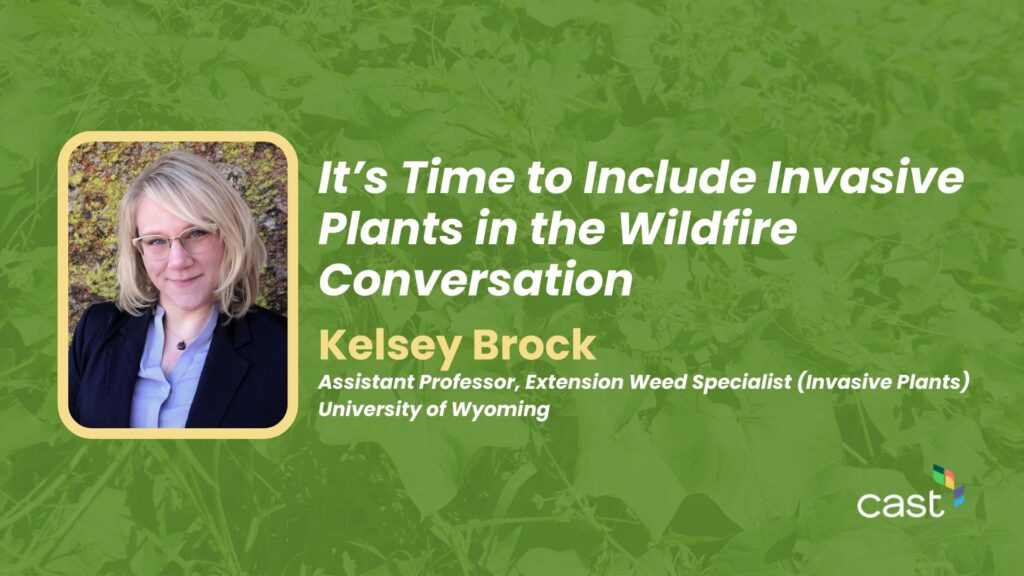

By Kelsey Brock
Assistant Professor, Extension Weed Specialist (Invasive Plants) | University of Wyoming
Wildfire is unpredictable to us in many ways. We don’t know when it will arrive, where it will spread, or how much damage it will do. But if you take the long view, wildfire is not completely random. Long before humans settled North America, many landscapes lived with a kind of fire rhythm steady enough in timing and character that ecosystems adapted to it. In forests, periodic fire cleared dead material and opened space for new growth. In grasslands, it kept landscapes open and productive.
Some plants are only harmed by fire, while some are built to survive it, and still others benefit from it. In places that burn often, some trees have thick bark to protect themselves from repeat burning. Other species are primed to capitalize on the moment after the fire: they can be highly flammable, increasing the chances of ignition, and when a fire eventually clears out competitors and releases nutrients, they resprout or germinate more quickly than other plants. In contrast, in ecosystems where fire came rarely, plants never acquired these kinds of strategies. Around the world, every region’s plants bear the signature of the fire rhythm they are accustomed to.
We often focus on climate change when we talk about today’s wildfires, and rightly so. Climate is a big part of the equation, but it doesn’t cause fire on its own. Invasive plants are rarely acknowledged as part of the wildfire problem, and a new publication from the Council for Agricultural Science and Technology, Weeds and Wildfires [coming in March 2026], aims to change that. Fire needs fuel, and when we introduce plants with one fire strategy into ecosystems built around another, that fuel changes. Some invasive plants load landscapes with highly flammable fine fuels that make landscapes ignite more readily, and some can change the fuel structure in ways that allow fires to burn hotter and cause more damage. Other invasive plants do the opposite, reducing the flammability of the lanscape and stretching out fire intervals in places that depend on frequent burns to maintain their function.
This matters because people have built their lives and communities around the old rhythms. We have learned how to live, recreate, manage resources, and grow food with certain expectations of how often fire comes and what it looks like when it does. When this changes, our way of life changes—sometimes for the worse. We see this in wildlife habitat lost, in grazable land reduced, and in rising fire suppression costs. Communities breathe more smoke, homes and infrastructure are lost, and livelihoods are disrupted. In the worst events, people lose their lives.
This is a big problem without simple solutions and the authors of Weeds and Wildfires are honest about that. Invasive plants don’t respect fence lines or borders, and once they’ve become well-established, it’s incredibly difficult to change an ecosystem back to what it was. We’re often dealing with vast landscapes, limited tools, and management budgets that can’t keep up with the spread of the species they are managing. But there is also reason for hope. This publication highlights that strong partnerships and thoughtful planning can make a tangible difference. And, some have found inventive ways to make the natural landscape work for us. For example, planting native succulent species along roadways in California, where many fires begin, can suppress invasive plants and reduce the likelihood of ignition.
Despite the challenges that come with managing invasive species, this is an issue we can influence. While climate change will likely continue to raise wildfire risk, we can reduce the fuels that invasive plants contribute. Strategic, coordinated efforts are essential if we want to keep the land resilient in a world where fire isn’t going away.
About Voices of Agriculture
The Voices of Agriculture series is designed to provide a platform for diverse perspectives on issues, trends, and experiences within the agricultural community. These articles aim to foster dialogue, share insights, and highlight the many voices that contribute to the ongoing conversation about agriculture and its future.
Disclaimer
The opinions expressed in this article are solely those of the author. They do not necessarily represent the views, positions, or policies of the Council for Agricultural Science and Technology (CAST). CAST provides this space to encourage thoughtful discussion, but does not endorse any specific viewpoints shared in these pieces.