Skip to content
  • About
    • Who We Are
    • Staff
    • Governance
    • CAST Bylaws
    • SoAR Foundation
  • Careers
  • Directory
  • Contact
  • About
    • Who We Are
    • Staff
    • Governance
    • CAST Bylaws
    • SoAR Foundation
  • Careers
  • Directory
  • Contact
Join
Donate
Member Login
  • Publications
  • Programs
  • Membership
  • Awards
    • 2025 Borlaug CAST Communications Award
    • 2025 CAST Lifetime Achievement Award
    • CAST Science Communication Scholarship
    • President’s Award
    • Champion Award
  • News
  • Events
    • 2025 CAST Annual Meeting
  • Publications
  • Programs
  • Membership
  • Awards
    • 2025 Borlaug CAST Communications Award
    • 2025 CAST Lifetime Achievement Award
    • CAST Science Communication Scholarship
    • President’s Award
    • Champion Award
  • News
  • Events
    • 2025 CAST Annual Meeting

Home | Publications

  • November 12, 2024
Potential for U.S. Agriculture to Be Greenhouse Gas Negative
  • May 15, 2024
  • Issue Paper
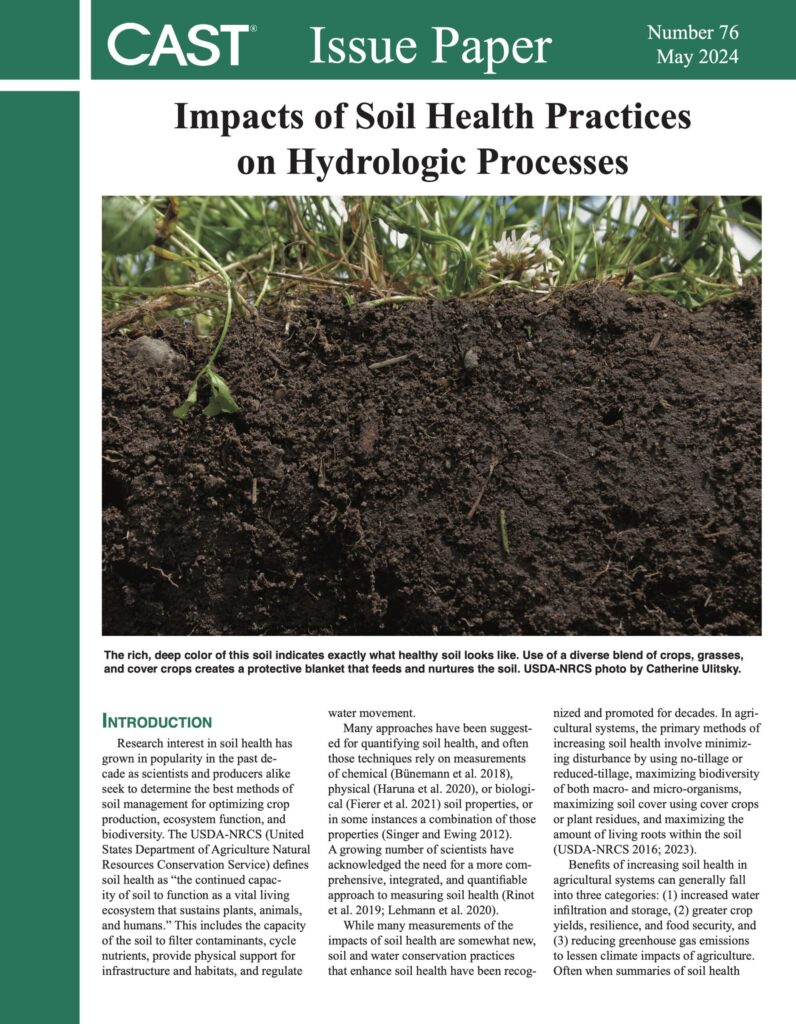
Impacts of Soil Health Practices on Hydrologic Processes
  • This paper explores the growing interest in soil health, emphasizing its importance in optimizing crop production, ecosystem function, and biodiversity. Defined by the USDA-NRCS as the soil's capacity to function as a vital ecosystem, soil health involves filtering contaminants, cycling nutrients, supporting infrastructure, and regulating water movement. Traditional approaches to quantifying soil health focus on chemical, physical, or biological properties, often calling for a more integrated measurement method. While practices enhancing soil health, such as no-tillage, cover crops, and biodiversity, have long been promoted, their broader impacts on the hydrologic cycle are less documented. This paper aims to fill this gap by reviewing the literature on soil health practices' effects on the hydrologic cycle and providing evidence and guidelines for policy- and decision-makers. It highlights the benefits of improved soil health, including increased water infiltration, higher crop yields, and reduced greenhouse gas emissions.
  • April 17, 2024
FIFRA, ESA, and Pesticide Consultation: Understanding and Addressing the Complexities
  • March 27, 2024
Preventing the Next Plant Invasion: Opportunities and Challenges
  • March 20, 2024
Applications, Benefits, and Challenges of Genome Edited Crops
  • March 12, 2024
State Regulatory Agencies as Conduit for Informing Local Conditions in Federal Pesticide Processes
Previous Page1 Page2 Page3 Page4 Page5 Next

Our Mission

CAST, through its network of experts, assembles, interprets, and communicates credible, balanced, science-based information to policymakers, the media, the private sector, and the public.

Join CAST

CAST, through its network of experts, assembles, interprets, and communicates credible, balanced, science-based information to policymakers, the media, the private sector, and the public.

Become A Member

Get In Touch

  • 2625 N Loop Dr #2610, Ames, IA 50010
  • (515) 766-5483
  • Office Hours: 8am - 5pm Mon. - Fri.
Contact Us

Follow Us

Linkedin Youtube Twitter Instagram Facebook Spotify

© Copyright CAST Science 2024. All Rights Reserved.

Privacy Policy | Terms of Use

Web Design and Development by Saltech Systems

  • Home
  • About
    • Who We Are
    • Staff
    • Governance
    • CAST Bylaws
  • Publications
  • Programs
  • Membership
  • Awards
    • 2025 Borlaug CAST Communications Award
    • 2025 CAST Lifetime Achievement Award
    • CAST Science Communication Scholarship
    • Champion Award
    • President’s Award
  • Events
    • 2025 CAST Annual Meeting
  • News
  • Careers
  • Contact
Member Login
Donate