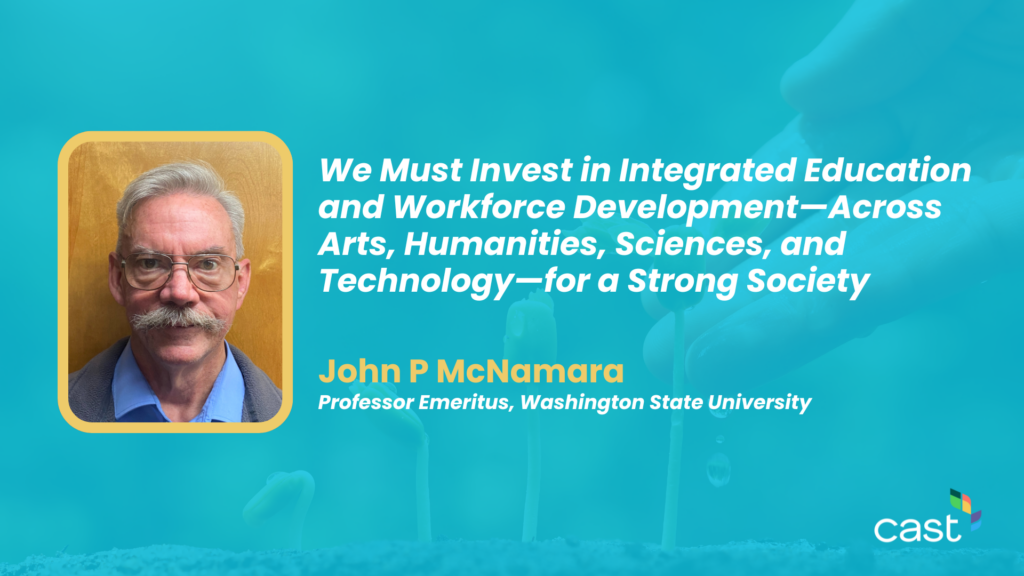

By John P McNamara
Professor Emeritus of Animal Sciences; Member, Washington State Academy of Sciences; Member, Board on Agriculture & Natural Resources (NASEM); ACES Enrollee, National Resource Conservation Services/USDA: Member, Select Committee on STEM Education & Rural Workforce Development; Past President, Washington Science Teachers Association
For more than fifty years, I have milked cows, fed pigs, walked beans, taught and advised students, worked with agricultural producers across Washington and the nation, and served on research and policy committees support our food system. From frozen pig feeders and warm dairy cows to Land Grant Universities, modern farms, students from all walks, to local, state, and federal agencies one reality exists: a strong, competitive, and resilient agriculture sector depends on a strong, well-educated, and versatile workforce. Today, that workforce must be more integrated, more interdisciplinary, and more technologically fluent than at any point in our history.
Agriculture is not just science and economics applied through hard work. It is the work of data science, economics, communication, ethics, engineering, sociology, environmental science, and creative problem-solving. Agriculture encompasses understanding local and global cultures, market narratives, global supply chains, and new digital tools that are constantly evolving.
Why Integration Matters
Education is often compartmentalized, but our greatest challenges and opportunities are inherently interdisciplinary. Farming demands environmental science, plant-animal interactions, economics, soil biology, local history and culture, community arts, and policy analysis. Food safety integrates microbiology, data analytics, regulatory affairs, and communication strategies that resonate with diverse audiences. Rural development depends on civic understanding, cultural competence, and the creative confidence that comes from the arts.
The next generation of people in the ag and food-system needs to navigate biological complexity and social complexity. They will need to interpret satellite imagery using machine learning while also understanding why a community might distrust new technologies. They will need to design supply-chain solutions and also tell the story of why these solutions matter.
The Role of Artificial Intelligence and Technology Tools
Artificial intelligence is not a threat to agricultural jobs—if we manage it with the dignity of all people involved in the food system, which, in fact, includes everyone. The promise of removing people from dangerous tasks so that they can do more efficient, meaningful, rewarding jobs has not yet been fulfilled.
We must use technology to dignify and uplift everyone. AI-powered tools now manage business decisions, identify plant diseases from smartphone photos, thin fruit tree flowers, weed fields without herbicides, identify genetically effective animals at birth, optimize irrigation schedules, prevent livestock metabolic disorders, improve supply chain efficiency, reduce waste, and increase margins. The true value of these tools depends entirely on people who know how to interpret them, adapt them, question them, and apply them wisely.
We must prepare students fully in science, business, data literacy, ethics, history, and communication. They need to understand biases and limitations of computer programs through cultural and local awareness. Graduates and present employees and employers will develop trustworthy digital platforms which require knowledge of governance and public policy. Designing user-friendly tools for diverse rural communities requires the creativity and empathy found in the arts and humanities.
Food and Agriculture System use of AI presently
Across Washington State and the broader U.S., integrated education is already reshaping agriculture:
- Precision livestock systems combine animal physiology, engineering, behavioral science, and AI to improve dairy cow health and farm profitability. These systems succeed because technicians and farm managers are trained across disciplines—not just in operating sensors, but in interpreting biological signals and communicating decisions effectively.
- Climate-resilient cropping programs combine soil science, climate modeling, history of land use, GIS mapping, and Indigenous knowledge. Students trained in integrated approaches are helping communities redesign cropping rotations, conserve water, and restore soils.
- Food-processing automation depends on mechanical engineering, human-factors psychology, economics, and computer vision. Processing plants now need workers who understand robotics and also understand the cultural and economic context of rural labor markets.
- Farm-to-school and local food initiatives rely on educators, nutrition specialists, artists, and farmers collaborating to connect children with the food system.
The workforce and consumers of the future must be cross-trained thinkers who can integrate biology, social science, ethics, engineering, and communication with emerging digital tools. They must not only know how to use technology, or appreciate the use of technology, but must be able to understand the complex interactions that define the state, nation, and world food system.
The Rural Workforce Imperative
Most people live in large cities, but most towns and small cities are in rural areas. These communities are home to enormous creativity, deep agricultural knowledge, and cultural resilience. However, reduced work opportunities, long commutes, declining population, limited broadband, fewer training centers, and fewer entry points for young people to see agriculture as a viable, high-skill career are making it harder to thrive.
A recent National Academy report on STEM Education and Workforce development in Rural areas showed that communities thrive when schools, businesses, and local organizations work together to offer interdisciplinary, hands-on learning connected to real workforce pathways. The payoff is substantial: higher graduation rates, stronger local employment, and an innovation pipeline that reaches every corner of the state.
Integrated education programs—throughout K-12 classrooms, community colleges, extension programs, and university partnerships—have proven especially powerful in rural regions. When students can connect STEM lessons to local history, arts, agriculture, and real economic opportunities, they stay engaged, they stay local, and they contribute to stronger rural economies.
What We Must Do
To secure a prosperous agricultural future, all people involved, across business, government, and education should:
- Invest in integrated K-12 and higher-education programs that connect the sciences, humanities, arts, and technology.
- Expand community-based workforce training that supports rural youth, mid-career adults, and farm families.
- Fund AI and data-driven agriculture research paired with ethical frameworks, communication training, and inclusive design.
- Strengthen Extension programs that translate interdisciplinary research into real-world practice.
A Call to Action
The food and agriculture system that feeds America is changing rapidly. We need creativity, adaptability, and a workforce that understands the intricate relationships among science, society, technology, and culture. If we invest boldly—in people, in places, and in knowledge that spans disciplines—we can build a food system that is productive, equitable, resilient, and deeply connected to the diverse communities it serves.
The future of American agriculture depends on it.