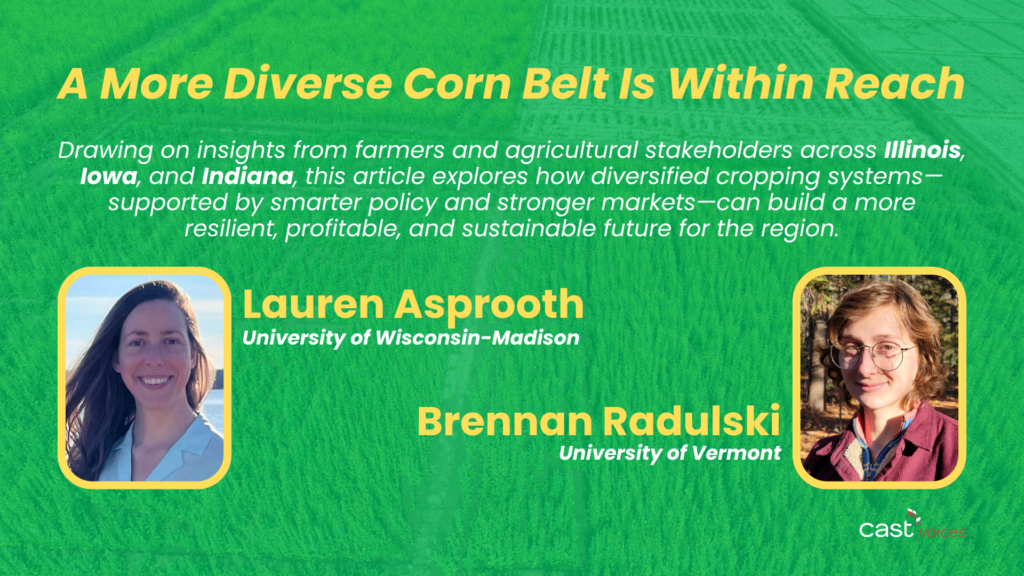

By Lauren Asprooth (University of Wisconsin-Madison) and Brennan Radulski (University of Vermont)
Unlike the diversified landscape of the early to mid 1900s, today 94% of cropland in the Corn Belt states of Illinois, Iowa, and Indiana is dedicated to the monocultural production of corn and soybeans. There is no doubt our current way of farming has brought record breaking productivity and driven farmer economic wellbeing over the last century. But commodity grain farming today has become a risky business. Farmers contend with the rising cost of inputs, increasingly low and volatile prices, extreme weather events, and trade wars that threaten the markets they depend on. As Senator Boozman, Chairman for the Committee on Agriculture, Nutrition, and Forestry recently said, “No row crop is currently profitable” (US Senate Committee on Agriculture, Nutrition, and Forestry 2026).
A different system is possible—one that not only benefits farmers, but benefits eaters, the land, and rural communities. Corn and soybeans aren’t going anywhere, but adding diversity, whether that be extending a crop rotation, grazing cattle on cover crops, or trying a perennial bioenergy crop on marginal lands, can support more financially and ecologically resilient farming operations. Farmers can spread risk across multiple products and markets and distribute labor, machinery, and income throughout more of the year. Adding third and fourth crops to corn and soybean rotations like small grains, legumes, or oilseeds can replenish degraded soils, lower the use of chemical inputs, reduce nutrient leaching and runoff, and add needed biodiversity to the landscape. New enterprises can breathe much-needed life into rural communities, allowing more kids to come back to the farm through activities that generate more income on fewer acres (i.e., value-added products, agritourism, direct to market sales) and creating new employment opportunities through added local processing and manufacturing.
Additionally, growing a variety of food crops including fruits and vegetables can help ensure our domestic and local food security in a time of increasing geopolitical and climate uncertainty. Today the US imports almost 60% of fresh fruit and 35% of vegetables. Almost half of our domestic fresh fruit and vegetable production comes from California, a state contenting with water shortages that threaten the long-term viability of the industry. We would be wise to consider increasing and better supporting horticultural production in the Corn Belt as a buffer against the growing frequency of trade and supply chain disruptions.
But to support diversification, we need to align farm policy with diversification goals and ensure the proper incentives and markets are in place across the supply chain. Farm policies like subsidized crop insurance, commodity payments, and state sponsored research and development helped this system to come into being, and in recent years, most commodity crop farmers rely on government payments and subsidies to stay afloat. That is to say, policy has had a critical role to play in creating an enabling environment for the current monoculture. And it can create an enabling environment for diversification.
Today, the array of programs and policies shaping US agricultural production are at times counter to and certainly lack the potential to supporting diversified agriculture. Through a research project called the Diverse Corn Belt, we held a series of visioning sessions in Iowa, Illinois, and Indiana called “Reimagining Agricultural Diversity” team meetings. We brought together a broad range of farmers and agricultural stakeholders to share their concerns with the current system and to collectively identify the top policy priorities for creating an enabling environment for diversification. Over three years, 10 sessions, and 178 participants, followed by months of transcript analysis and consultation with policy experts, we came to four key policy pathways to help break the Corn Belt’s corn-soy dependence: reforms to crop insurance, changes to Farm Bill conservation programs, support for post-harvest market infrastructure, and institutional procurement of diverse local food products. Within these pathways, we identified 19 specific opportunities that reflect the full range of perspectives we heard, spanning both systemic and incremental changes from reducing taxpayer subsidies to crop insurance premiums to stepping up institutional purchasing of diverse local food products.
Through this research, we illustrate the breadth of strategies available to advance diversification, strategies that meet tangible needs expressed by those closest to the work. The path forward is not about replacing corn and soybeans, but about building a more flexible and resilient system around them. Farmers, researchers, industry leaders, and policymakers all have a role to play, but meaningful change will require policy that supports, rather than hinders, diversification. The tools exist, now it’s time to put them to work.
- Want to go deeper? CAST and the Diverse Corn Belt Project are hosting a free public webinar on Tuesday, April 14, at 11 a.m. CT | Noon ET, featuring the researchers behind the paper Diversifying the Corn Belt: Policy Pathways for a Resilient Agricultural Future — led by Lauren Asprooth (University of Wisconsin-Madison) and Brennan Radulski (University of Vermont). Register now!
___
About Voices of Agriculture
The Voices of Agriculture series is designed to provide a platform for diverse perspectives on issues, trends, and experiences within the agricultural community. These articles aim to foster dialogue, share insights, and highlight the many voices that contribute to the ongoing conversation about agriculture and its future.
Disclaimer
The opinions expressed in this article are solely those of the author. They do not necessarily represent the views, positions, or policies of the Council for Agricultural Science and Technology (CAST). CAST provides this space to encourage thoughtful discussion, but does not endorse any specific viewpoints shared in these pieces.