
The Council for Agricultural Science and Technology (CAST) has two free public webinars scheduled this April — one presenting a new policy brief on agricultural diversification in the U.S. Corn Belt, and one offering a live demonstration of digital tools for soil fertility and nutrient management. Both sessions are open to all and designed to connect science directly with the people who need it most.
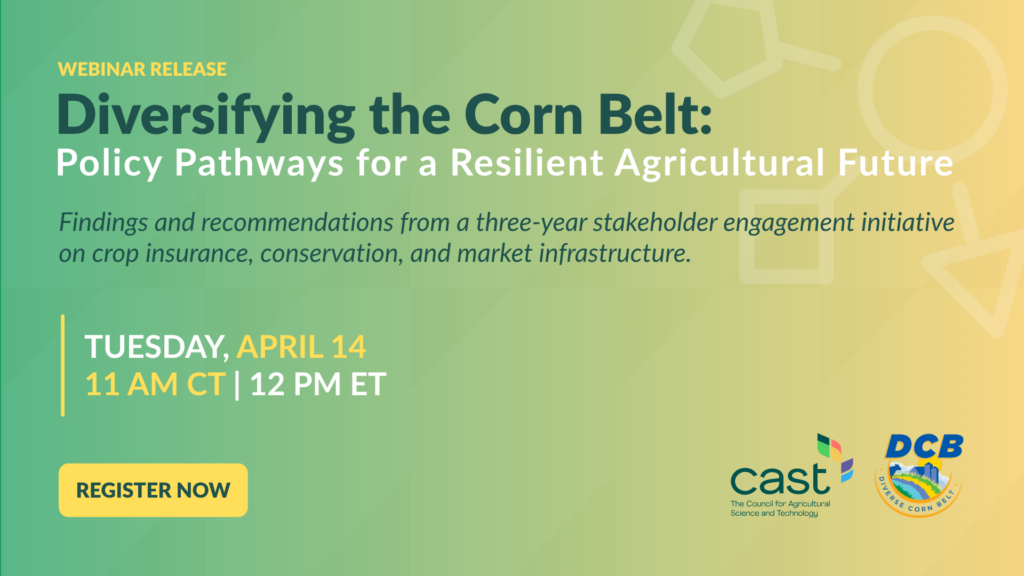
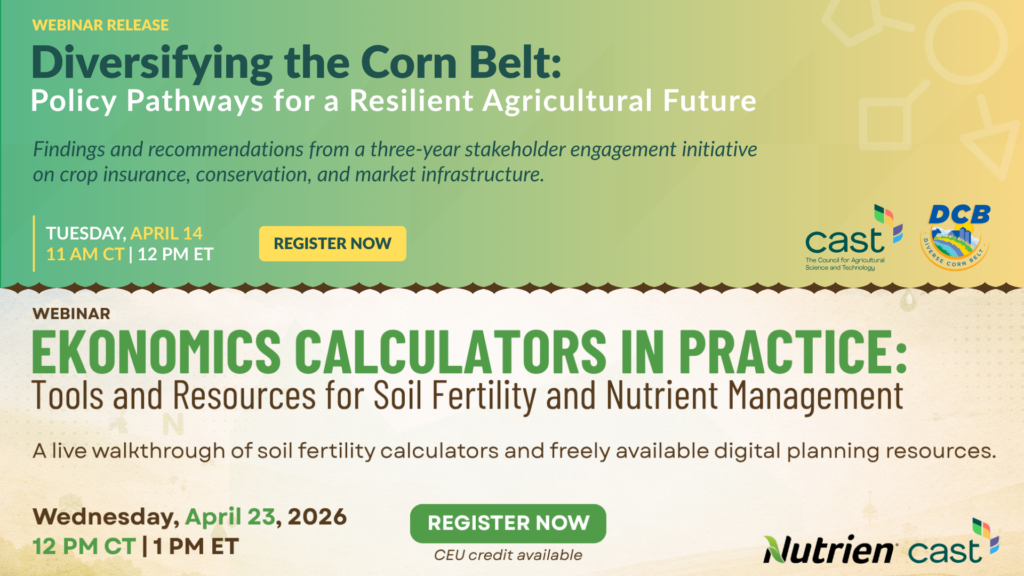
- APRIL 14 | Diversifying the Corn Belt: Policy Pathways for a Resilient Agricultural Future Tuesday, April 14, 2026 | 11 a.m. CT (Noon ET) | Free
CAST and Diverse Corn Belt will host a free public webinar on April 14 presenting the release of Diversifying the Corn Belt: Policy Pathways for a Resilient Agricultural Future, a new CAST policy brief examining how federal and state policy can support agricultural diversification in Illinois, Iowa and Indiana.
The brief is the result of three years of participatory research. The team conducted 10 stakeholder meetings with 178 participants, surveyed 725 farmers and engaged 136 additional producers through focus groups and interviews. Participants included farmers, landowners, extension staff, policymakers, processors and market representatives.
In the three-state region covered by the research, 94% of crop production is currently dedicated to corn and soybeans. The brief identifies 19 policy opportunities — ranked by feasibility and transformative potential — across four areas: federal crop insurance, Farm Bill conservation programs, post-harvest market infrastructure and institutional procurement.
Among the research findings, federal crop insurance is primarily structured around commodity crops, making it more difficult and costly to insure alternative crops. The Whole Farm Revenue Protection Program, designed for diversified operations, is widely noted as difficult to use. Conservation programs under Farm Bill Title II offer limited support for production diversity as a primary goal. Post-harvest infrastructure for processing and distributing diversified products has declined significantly across the region, and institutional buyers face structural barriers to sourcing local products at scale.
The webinar will be presented by co-first authors Lauren Asprooth, food systems scientist at the University of Wisconsin-Madison, and Brennan Radulski, postdoctoral researcher at the University of Vermont, alongside a team of 19 researchers and practitioners. The session will include a review of the ranked policy opportunities and a live Q&A with attendees.
“CAST was built on the idea that science should inform the policies that shape American agriculture,” said Chris Boomsma, CEO of CAST. “This brief brings farmer voices and rigorous research together to give policymakers a clear, evidence-based picture of the opportunities available.”
- APRIL 23 | eKonomics Calculators in Practice: Tools and Resources for Soil Fertility and Nutrient Management Wednesday, April 23, 2026 | Noon CDT | 1 p.m. EDT | Free | 1 Science Societies CEU credit
On April 23, CAST and Nutrien will co-host a free, one-hour webinar bringing digital soil fertility and nutrient management tools directly to agronomists, crop consultants and farmers.
The session will feature Lyle Cowell, Senior Agronomist at Nutrien, who will lead a live walkthrough of the eKonomics platform — including hands-on demonstrations of the Input Planning and Dry Fertilizer calculators. Cowell will also guide attendees through a range of freely available digital resources covering research content, geographic soil data, crop guides, return-on-investment tools and continuing education opportunities available through the platform.
Cowell is based in northeast Saskatchewan, where he has spent his career in agronomy with a focus on soil management, connecting research, extension and farm-gate application of soil fertility principles.
The session is free, open to all and eligible for 1 Science Societies CEU credit for professional development.