
By Alex Thomasson
Professor, Department Head, and William B. and Sherry Berry Endowed Chair | Mississippi State University
When most people who understand farming hear the term, agricultural equipment, they imagine machines like tractors and combines and implements for tilling, planting, spraying, and spreading. Since the advent of farm machinery, these machines have been largely mechanical, and they have grown larger over time to maximize the efficiency of the person driving the machine. Over the last 30 years or so, however, these machines have grown in sophistication to include more electrical, digital, automation, communications, and even AI-based technologies. It is common today for a new tractor to come with a highly precise GPS system, automatic steering that surpasses human driving capabilities, data collection systems that enable mapping of crop yield and quality, and communications systems that enable data to be automatically transmitted to a cloud-based data repository and analysis system. We’re transitioning from automating specific tasks (e.g., automatic navigation) to autonomy, in which machines can drive themselves through a field, make agronomic decisions at a particular place and time, and carry out “smart” farming by themselves with humans overseeing their progress and performance. When we reach such full autonomy, machines no longer need to be very large, because we no longer need to maximize the efficiency of the person driving the machine, because there is no person physically driving the machine. Thus, autonomous machines of the future are likely to be smaller, enabling higher precision, lower soil compaction, and greater reliability (imagine five smaller machines doing the job of one large machine; if one machine fails, the other four can continue working). We’re not there yet, but…
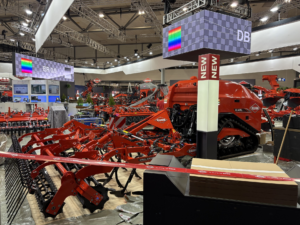
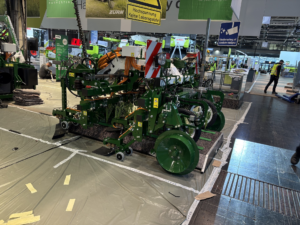
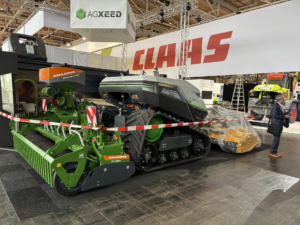
Along with thousands of other attendees, I just attended Agritechnica, the world’s largest farm machinery show in Hannover, Germany (https://www.agritechnica.com/en/). It’s an amazing show with 20+ convention-center size buildings full of farm equipment and other technologies, from tractors to combines to planters and sprayers and tillage equipment, plus software solutions and everything in between. I left with three clear takeaways from this year’s meeting that signal trends for the future:
- Many – far more than ever before – robots and autonomous solutions including laser-weeding machines, spray drones, etc. Virtually every major company (Deere, Claas, Case, Fendt, etc.) had some type of autonomous machine in their display. These machines are not necessarily ready for sale, but they definitely pointed to where the market is going. One of my traveling colleagues, John Fulton of Ohio State University, said, “if you want to keep up with the Joneses, you have to have a robot in your display.”
- I perceived that, of the many thousands of attendees, a lot more this year were from far beyond Germany; I saw people from all six inhabited continents. This show is getting bigger and becoming a destination like CES, the annual Las Vegas based trade show organized by the Consumer Technology Association. Agritechnica is held every other year in Hannover, so if you’re planning to go in 2027, I highly recommend very comfortable shoes, because there’s a lot of walking to be done.
- While the businesses with the biggest display spaces are the major manufacturers in Europe and North America, I noticed a large and growing number of Chinese businesses this year. These displays included aerial drones and ground-based robots and everything in between. China is clearly putting itself out there as not only an agricultural equipment provider, but also as a provider of high-tech and futuristic agricultural solutions.
Technology development in the agricultural equipment industry is moving fast. Agriculture is still highly complex – with tremendous variation in cropping systems, topography, soils, regional climates, pest infestations, etc. – so we won’t convert ubiquitously to autonomous machines overnight, but things are definitely trending in that direction. Stay tuned over the next decade or two.
About Voices of Agriculture
The Voices of Agriculture series is designed to provide a platform for diverse perspectives on issues, trends, and experiences within the agricultural community. These articles aim to foster dialogue, share insights, and highlight the many voices that contribute to the ongoing conversation about agriculture and its future.
Disclaimer
The opinions expressed in this article are solely those of the author. They do not necessarily represent the views, positions, or policies of the Council for Agricultural Science and Technology (CAST). CAST provides this space to encourage thoughtful discussion, but does not endorse any specific viewpoints shared in these pieces.