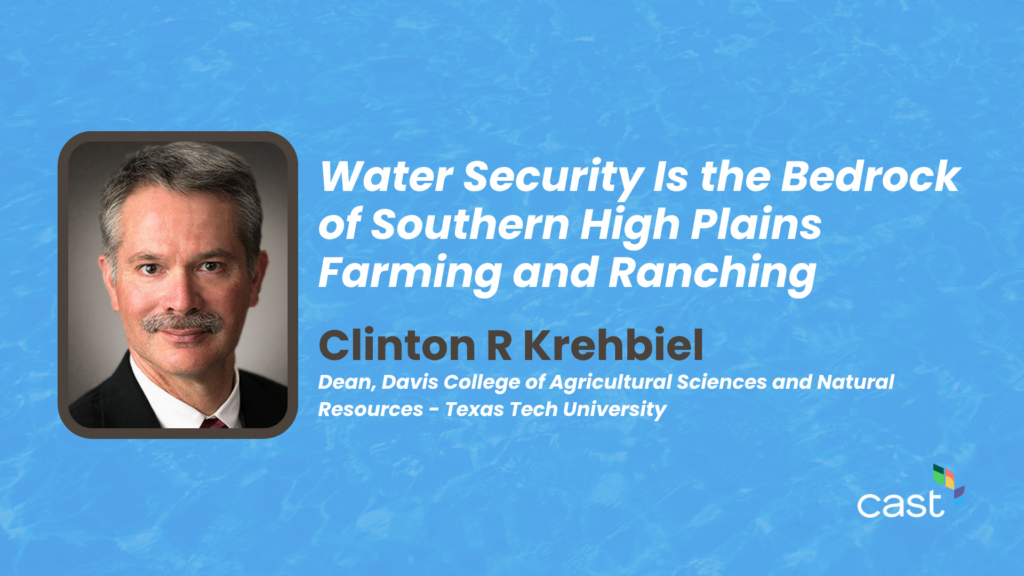

By Clinton R Krehbiel
Dean, Davis College of Agricultural Sciences and Natural Resources – Texas Tech University
West Texas is a land of grit and determination. From the cotton fields surrounding Lubbock to the ranchlands of the Edwards Plateau and Trans-Pecos, our communities have built livelihoods in semi-arid landscapes. However, that hard-won resilience faces threats. Water — the most critical resource for crop and livestock production — is becoming less reliable. Without strong action to secure water for agriculture, the economic, cultural, and ecological fabric of the Southern High Plains and similar semi-arid regions nationwide is at risk.
Farmers and ranchers in semi-arid regions have always dealt with and adapted to water-scarce scenarios. Drought-tolerant crop varieties, rotational grazing, managing irrigation scheduling, and investing in water-saving technologies have helped reduce risk. However, the scale and speed of change they now face — driven by extended drought cycles, declining aquifers, and competing demands from growing cities and energy development — surpass traditional adaptation methods. The Ogallala Aquifer, which supports millions of acres of farmland across the Southern High Plains, is a clear example: decades of heavy pumping have caused significant drops in groundwater levels. In many areas, especially the Southern High Plains, pumping far exceeds natural recharge. This imbalance threatens long-term productivity and forces difficult decisions about which land can realistically stay in production.
Water insecurity impacts agriculture on multiple fronts. For crops, insufficient water reduces yields, lowers quality, and increases the risk of complete crop failure in extreme years. For livestock, limited water reduces pasture productivity, forces herd reductions, and raises feed costs when forage quantity and quality declines. The ripple effects extend beyond farm gates: rural economies dependent on agriculture suffer, local food supplies become less reliable, and the cultural heritage of farming and ranching communities erodes.
Addressing water security in semi-arid regions requires a multifaceted approach rooted in science, incentives, and collaboration.
- Invest in efficient irrigation and soil Modern irrigation systems—center pivots with low-pressure sprinklers, drip irrigation where feasible, and precision application guided by soil moisture sensors and remote sensing—can substantially improve water use productivity. Equally important are soil health practices: no-till, cover crops, and residue management improve infiltration and water-holding capacity, allowing crops to withstand dry periods with less irrigation.
- Scale voluntary locally led ground water Sustainable use of groundwater must be community-driven and science-based. Regulatory top-down mandates often produce resistance and unintended economic harm if not paired with local buy-in and equitable transition plans. Programs that support well metering, data sharing, and collaborative water budgets help communities monitor aquifer health and plan phased reductions in pumping while protecting the viability of farms and rural communities.
- Expand market-based tools and compensation for water stewardship. Incentives such as conservation easements for fallowing, water leasing markets that allow cities and agriculture to share water in dry years, and payments for ecosystem services can temporarily reallocate water without permanently removing productive land from agriculture. These tools must be designed to prioritize long-term resilience and fairness to landowners and farm workers.
- Prioritize research and outreach for semi-arid systems. Breeding crops for drought tolerance, developing and introducing new forage species suited to hotter, drier summers, refining pasture recovery strategies, and improving water-use models are essential. These advances must be delivered to producers in practical and affordable ways, helping them integrate new practices into their business plans.
- Strengthen agricultural water accounting and transparency. Reliable data on groundwater withdrawals, surface-water diversions, and return flows are critical for planning. Investments in monitoring networks and open-access data systems give communities and policymakers the information needed to make informed, equitable
- Plan for diversified rural Even with the best management, some land use change will be inevitable. Supporting rural economies through value-added processing, renewable energy co-located with agriculture (agrivoltaics), and conservation-based tourism can ease transitions and keep towns vibrant.
Finally, decisions about water are as much social and political as technical. Urban growth and industrial water use are legitimate needs, but so is the right of farmers and ranchers to plan viable livelihoods. Forums where all stakeholders — producers, municipalities, industry, conservation groups, small rural communities — negotiate transparent, long-term solutions.
Water security in West Texas and similar semi-arid regions isn’t just an agricultural issue; it’s an economic and community one. When groundwater drops, and wells go dry, the consequences cascade through supply chains, labor markets, and local identities built around the region. Conversely, smart investments and collaborative governance can sustain production, protect rural communities, and preserve the stewardship ethic that has kept these landscapes working for generations.
For ranchers and farmers, water is both livelihood and legacy. Protecting that legacy will require innovation, investment, and the political will to prioritize sustainable, equitable water management. The future of agriculture in West Texas depends on it — and so does the resilience of the communities that call this landscape home.
___
About Voices of Agriculture
The Voices of Agriculture series is designed to provide a platform for diverse perspectives on issues, trends, and experiences within the agricultural community. These articles aim to foster dialogue, share insights, and highlight the many voices that contribute to the ongoing conversation about agriculture and its future.
Disclaimer
The opinions expressed in this article are solely those of the author. They do not necessarily represent the views, positions, or policies of the Council for Agricultural Science and Technology (CAST). CAST provides this space to encourage thoughtful discussion, but does not endorse any specific viewpoints shared in these pieces.