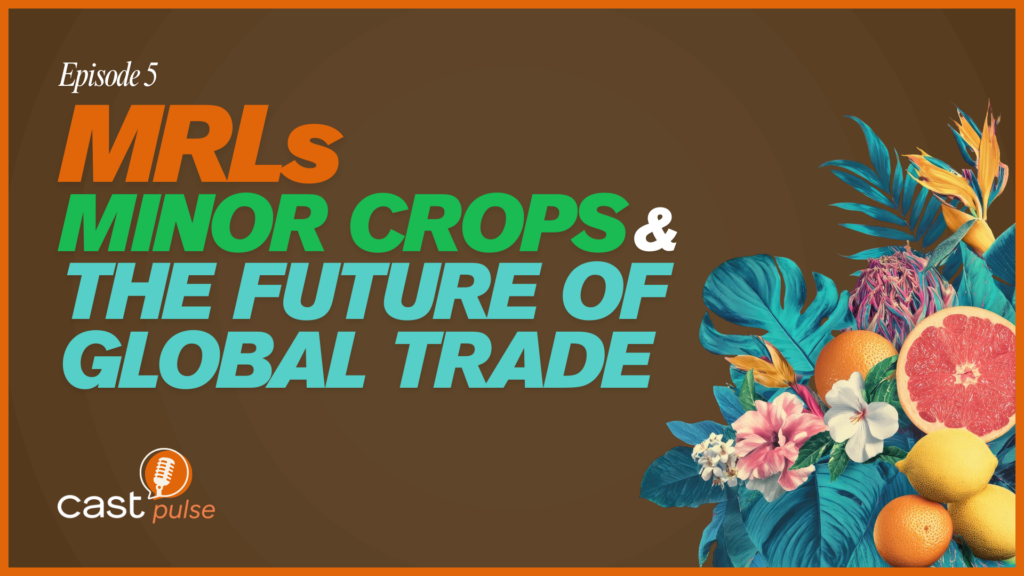

What happens when the rules governing pesticide residues in food don’t align across borders? For farmers growing minor and specialty crops — think tropical fruits, nuts, vegetables, and spices — the answer can mean lost markets, rejected shipments, and shrinking profitability.
In Episode 5 of the CAST Pulse Podcast, CAST’s Programs and Engagement Manager Kaylee Kleitsch sits down with Alan Norden, Secretary of the Minor Use Foundation Board of Directors. Alan brings over 26 years of experience in pesticide regulation with the Australian Pesticides and Veterinary Medicines Authority, where he served as Executive Director of Registration Management and Director of Minor Use. He has chaired the OECD Expert Group on Minor Uses and contributed to key international guidance documents on regulatory incentives and the use of global data. He is also the chair of an upcoming CAST paper on Maximum Residue Levels.
In this conversation, Alan breaks down what maximum residue limits (MRLs) are, how they’re established, and why missing or misaligned MRLs create real barriers for growers and exporters around the world. He also discusses the science behind MRL-setting, the push toward global harmonization, and why risk-based policy systems are critical for ensuring farmers have access to safe and effective crop protection tools.
Also in this episode: CAST’s upcoming publication Integrated Management of Fire-Adapted Invasive Plants That Change Wildfire Regimes releases in March, with a live webinar on April 8th at 1 PM Eastern. Registration opening soon.
Learn more about the Minor Use Foundation at minorusefoundation.org.
About the CAST
Pulse Podcast The CAST Pulse Podcast releases a new episode every Wednesday, featuring conversations on agricultural innovation, science communication, and policy with experts, students, and leaders across the agricultural sciences.
Disclaimer
The opinions expressed in this podcast are solely those of the guests. They do not necessarily represent the views, positions, or policies of the Council for Agricultural Science and Technology (CAST). CAST provides this platform to encourage thoughtful dialogue on issues relevant to agricultural science and its future, but does not endorse any specific viewpoints shared by podcast guests.