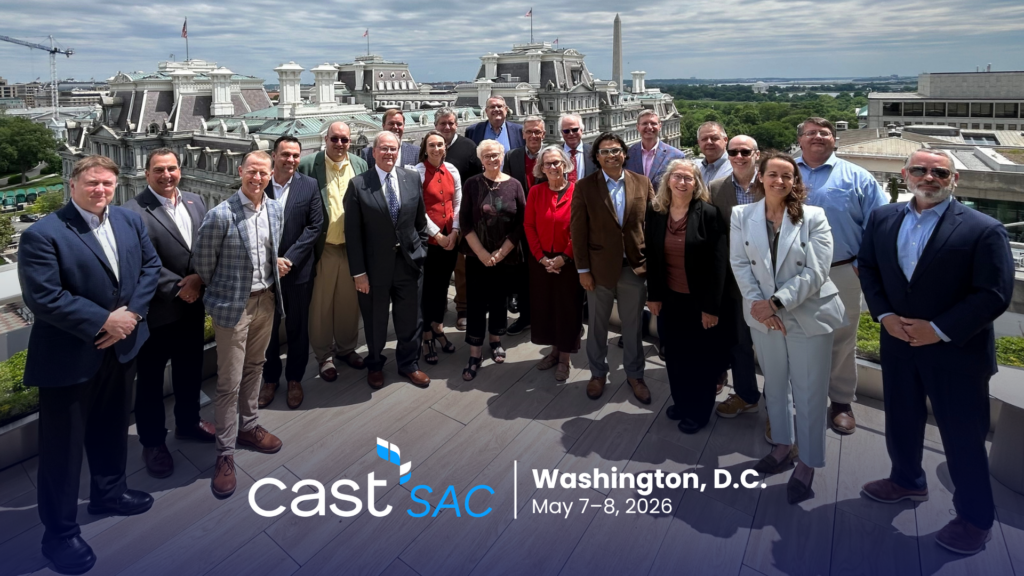

The Council for Agricultural Science and Technology’s Strategic Advisory Council (SAC) completed its first in-person gathering in Washington, D.C. on May 7–8, 2026 — a landmark two-day working session that moved CAST from strategic ambition to concrete institutional direction.
Day One: Establishing Shared Reality
The first day brought together SAC members and distinguished guest speakers for a rigorous, wide-ranging conversation. Participants represented the full breadth of the agricultural enterprise — including legal, policy, congressional, and national security perspectives, alongside voices from technology, academia, and the farmer community — ensuring the discussion extended well beyond Washington and reflected the real complexity of American agriculture.
Their collective charge was not to debate institutional models out of the gate, but to establish a shared, reality-tested understanding of the systemic gaps shaping U.S. agricultural science, technology, and policy today. Speakers and participants offered candid, practitioner-level insight into where agricultural innovation succeeds, where it stalls, and what it would take for a new or evolved institution to earn and sustain the trust of policymakers, funders, and the broader scientific community. By the close of Day One, the SAC had meaningfully narrowed the range of plausible institutional futures — identifying which paths cannot credibly meet national need and which remain viable.
Day Two: From Direction to Decision
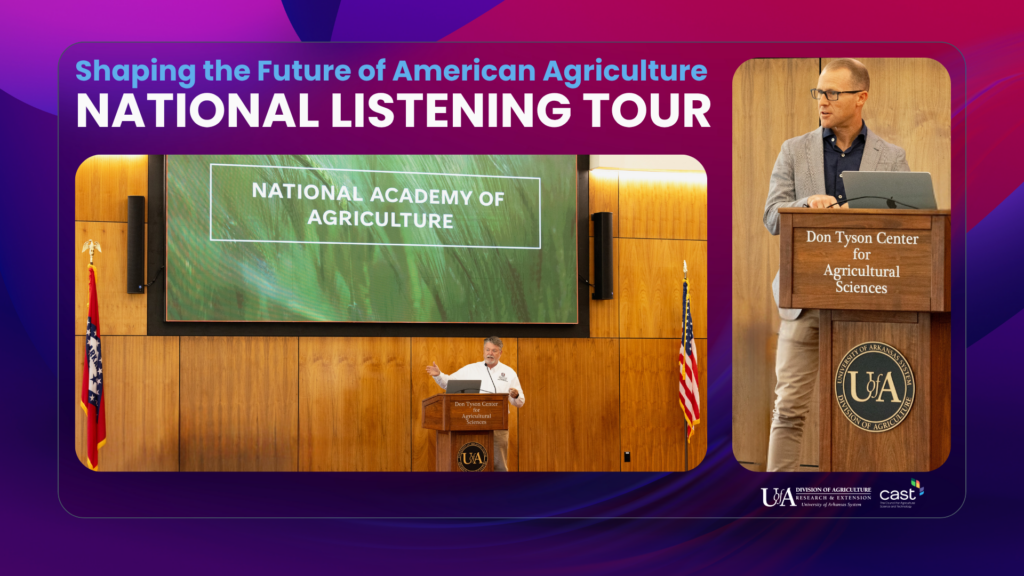
Day Two translated the shared foundation of Day One into concrete institutional direction. Participants examined three distinct organizational models — an enhanced coalition model building on CAST’s existing strengths, an independent think tank focused on agile policy-relevant analysis, and a National Academy of Agriculture — weighing each against real-world considerations of credibility, funding, governance, and impact.
The discussion was notable for its breadth and candor. Participants stressed the need for a new entity that goes beyond knowledge generation to actively facilitate the adoption of solutions — serving as convener, creator, and disseminator across the full agricultural value chain. Inclusivity emerged as a defining principle, with strong emphasis on engaging diverse voices from producers, academia, industry, policymakers, and consumers, as well as perspectives from outside traditional agriculture including energy, medicine, and technology sectors.
The group also grappled directly with the hard questions of funding integrity, governance transparency, and how to balance rigorous scientific analysis with effective advocacy — without compromising credibility or becoming a lobbying vehicle.
By the close of Day Two, the SAC had produced clear directional guidance for CAST leadership and the Board to act upon, with immediate next steps identified around organizational structure, funding model exploration, and stakeholder engagement.
What Comes Next
The SAC’s recommendations will now move to the CAST Board, with follow-on workstreams expected to address governance, legal structure, funding, and external partnerships. CAST will share further updates as this process advances.