
by Julia Valliant
Farms for a New Generation Director, American Farmland Trust
Like clouds in the sky or waves on the ocean, farms and ranches are always in motion. Even as they’re fixed in place, farms move through the seasons, and they move through generations of people who care for them, from one steward to the next. Farm successions or handoffs may not capture much public attention. But these changeovers of a farm from one person to the next, one family to the next, underlie our agriculture and food systems. How farms change ownership is pivotal for our present and our future.
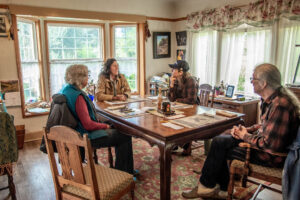 A farm’s succession affects its capacity to move in directions that are better – or worse – for next-generation farmers and ranchers, ecologies, and food systems. How aging farm owners prepare for what comes next can position future stewards to thrive. Succession planning can prepare farms to embrace conservation methods, diversify products and enterprises, build income, and employ more people. But, as the USDA released in April 2026, most farmers who are retirement age have no succession plan at all. This tendency to put off succession planning is one cause of an imbalance: farmers aged 75 and older outnumber farmers under 35 by two to one. Avoiding planning for a farm’s inevitable succession skews our agriculture, and it can set the next generation up for struggle.
Helping farmers prepare for succession leads to broad benefits: for the farm business, the elder generation’s legacy, the junior generation’s opportunity, the surrounding community, and the earth itself. Since meaningful planning to hand off a farm is complex and can take time, farmers benefit from having someone by their side to help navigate the complexities.
This is a primary role of the Farms for a New Generation (FNG) team of American Farmland Trust. As FNG’s director, I see the impact of this support firsthand. Through robust partner networks around the country, one-on-one support, and shared resources, our team coaches people through farm and ranch succession. Every farmer, rancher, and landowner has their own vision for moving along to the next operator—each situation is unique. Our network of Land Transfer Navigators honors these visions and accompanies farmers through this time of preparation and change. Think of other transformative eras in life – times of birthing, childrearing, and dying. These processes take time and alternate lulls with periods that move fast. Along the way, companions offer guidance and support. During times of intense change, it’s helpful for someone to stand with us. That’s the power of the proverbial village.
 Farming isn’t an easy business to pass along the baton. Even though most farm families earn off-farm income, their liquid assets are often limited. Much of a farm family’s net worth is tied up in the land itself; to extract it, land must be rented out or sold. To transition from one generation to the next while holding onto land, the farm’s income needs to swell for a time to employ more people, and maybe even increase the land base. In today’s agricultural economy, that’s tough.
These financial barriers usually combine with farm families’ dearest relationships. It’s normal for succession conversations to bring up difficult emotions. Because of that, Families may avoid these discussions altogether. It’s not easy to talk about death, and retiring is tough when your livelihood is also your identity and your homeplace.
Navigators help farm families of all kinds to broach these tender topics. They help with the numbers. Help with the relationships. Help with the bravery and clarity of the words.
 It’s a big achievement to create and stick to a succession plan, especially one that features clear communication and mutual agreement among parties. Even the simplest plans can be a major lift. Yet we’re now in an era of inviting farm and ranch owners to go beyond the typical succession approaches, to take on challenges our moment offers. Of course, farm owners want to give a gift of land wealth to their descendants, and U.S. tax policy leads us to do just that. Unfortunately, the people who inherit an equally divided farm often face huge financial barriers to doing anything but turning around and selling that farm to the highest bidder. Bidders are happy to oblige. Increasingly, these buyers are real estate developers, investors, and established larger-scale farm operations. In response, the price of land is soaring—and that’s pricing out America’s next farmers and ranchers. To keep small and mid-scale family farms alive, and build our local and regional food systems alongside domestic food security, farm owners need to envision and map out their succession with creativity and intention, adapting to the perpetual motion they are in.
To do that, they need help. Advisors can bring farmers’ visions to life for who will own and care for the land next, and they can usher in opportunity for America’s next farmers and ranchers. This sort of support isn’t a “nice-to-have”; it is a necessity. Individual farms and ranches, rural communities, and our food system depend on it.
___
About Voices of Agriculture
The Voices of Agriculture series is designed to provide a platform for diverse perspectives on issues, trends, and experiences within the agricultural community. These articles aim to foster dialogue, share insights, and highlight the many voices that contribute to the ongoing conversation about agriculture and its future.
Disclaimer
The opinions expressed in this article are solely those of the author. They do not necessarily represent the views, positions, or policies of the Council for Agricultural Science and Technology (CAST). CAST provides this space to encourage thoughtful discussion, but does not endorse any specific viewpoints shared in these pieces.