The full 2026 CAST OJS Analytics Report covers platform-wide engagement metrics, traffic concentration analysis, per-publication performance, decade-by-decade breakdowns, multilingual publication data, and recommendations for content strategy and catalog stewardship.
By
Communications Office
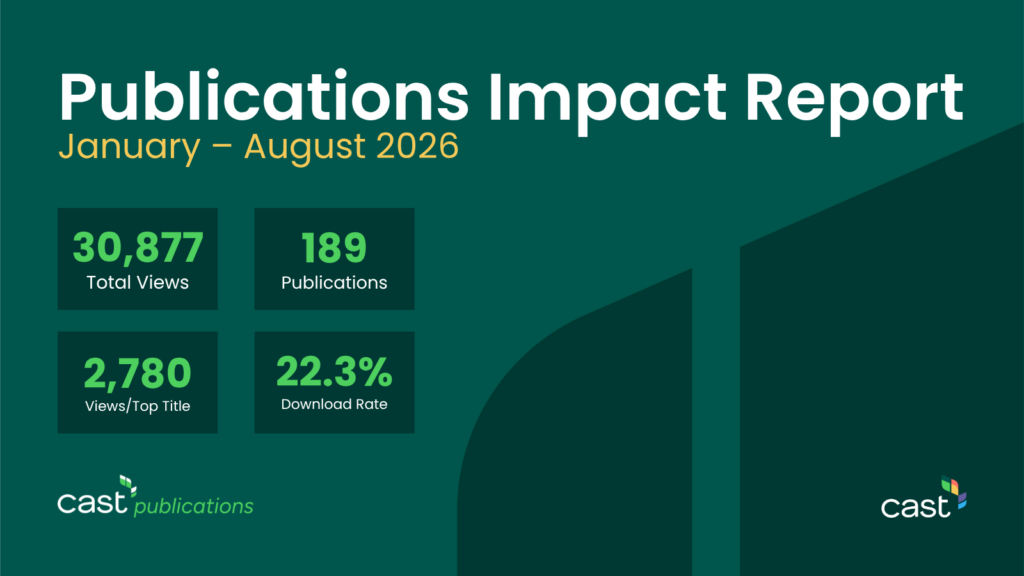
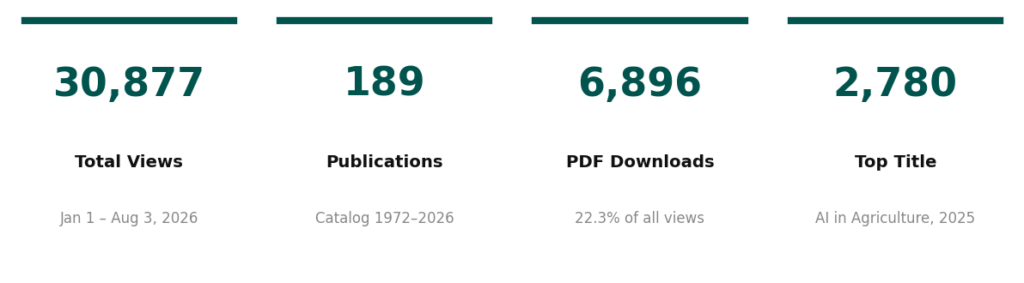
CAST’s Open Journal Systems (OJS) platform recorded 30,877 total views across 189 publications in the first seven months of 2026 — a snapshot of how agricultural science is being read, downloaded, and used by researchers, regulators, policymakers, and the public.
The full 2026 Analytics Report is now available. Here’s what the data shows.
The most-read publication of 2026 so far is AI in Agriculture: Opportunities, Challenges, and Recommendations (2025), with 2,780 views. Close behind it: Integrated Management of Fire-Adapted Invasive Plants That Change Wildfire Regimes (2026), a new release that has already attracted 2,666 views — reflecting strong public and policy interest in wildfire management and invasive species as climate pressures intensify.
Three of the top five titles were published in 2025 or 2026, signaling that CAST’s recent work is reaching audiences quickly. The top 10 titles together account for 41.9% of all platform traffic.
Top 10 CAST publications by total views, January–August 2026. Darker bars = 2025–2026 titles.
A Catalog That Spans Generations
CAST’s publication archive runs from 1972 to the present — and older titles are still pulling readers. The 2020–2026 cohort generates 62.6% of total platform traffic, but publications from every decade remain in circulation.
Agricultural Science and the Public, originally published in 1972, recorded 319 views in the first seven months of 2026 — outperforming the majority of titles published in the 1990s and 2000s. The data shows that peer-reviewed agricultural science doesn’t age out of relevance.
Total views and average views per publication, grouped by decade. The line tracks per-publication engagement over time.
When Readers Download, It Means Something
The platform average download rate — PDF downloads as a share of total views — is 22.3%. Titles that exceed that benchmark significantly are typically being used for something: cited in a paper, incorporated into a regulatory filing, assigned in a course, or shared with a working group.
Mycotoxins: Risks in Plant, Animal, and Human Systems, published in 2003, has an 86% download rate — nearly four times the platform average. A document more than two decades old, still being retrieved by nearly every reader who finds it. Other high-download titles include publications on turfgrass water quality (66%), integrated pest management (57%), and aquatic plant control (57%).
On the newer end, Diversifying the Corn Belt: Policy Pathways for a Resilient Agricultural Future (2026) has a 49% download rate in its first months of availability — the highest among all high-traffic titles and a strong signal that it is reaching legislators, extension professionals, and farm organizations who need the full document.
Download rates for selected CAST publications. The dashed line marks the platform average (22.3%).
Regulatory Science in Action
Five CAST publications addressing the intersection of the Federal Insecticide, Fungicide, and Rodenticide Act (FIFRA) and the Endangered Species Act (ESA) generated a combined 1,676 views in the reporting period — placing the cluster fifth platform-wide if treated as a single title. Download rates across the five range from 17% to 23%, consistent with active use in pesticide consultation proceedings and regulatory policy work.
This is what coordinated publication strategy looks like in practice: a cluster of complementary titles, released across two years, building a comprehensive scientific record on a contested policy question.
About the Report
The full 2026 CAST OJS Analytics Report covers platform-wide engagement metrics, traffic concentration analysis, per-publication performance, decade-by-decade breakdowns, multilingual publication data, and recommendations for content strategy and catalog stewardship.
Data source: OJS statistics export (2026-08-04). All sections and issues included. Download rate figures reflect PDF file access only.