
Agriculture Enters the AI Era
A synthesis of current peer-reviewed science on the state of AI across U.S. agriculture and the food system — what it does today, where it is headed, and why policy matters.
Agriculture presents one of the world's most challenging environments for artificial intelligence — because weather, pests, and markets change continuously. These same characteristics make agriculture one of AI's most consequential application areas.
As AI advances, it is rapidly becoming a foundational technology across agriculture and the food system. Like mechanization, improved genetics, and precision agriculture before it, AI is expanding the capabilities of producers, researchers, and other agricultural stakeholders — enabling faster, better-informed, and increasingly automated decisions.
AI-based technologies are beginning to enable equipment and software to recognize biological and environmental conditions, support increasingly sophisticated decisions, and perform tasks that previously required continuous human observation or intervention. AI has implications not only for agricultural productivity, but also for food security, natural resource stewardship, rural economic development, workforce preparation, scientific research, and U.S. competitiveness.
From Sensing to Action
Agricultural AI combines four core capabilities — often within a single system — to transform raw observations into physical outcomes.
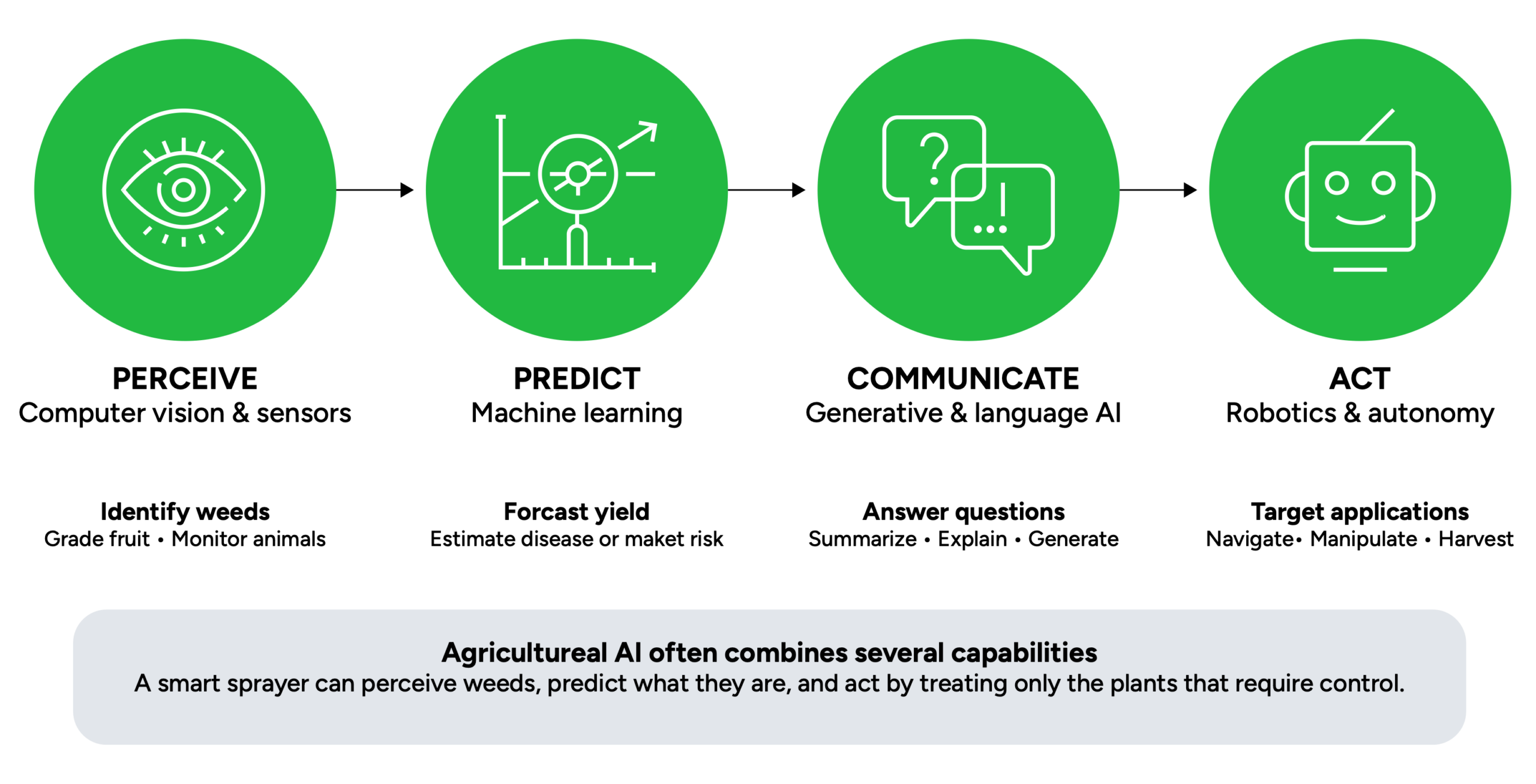
Figure 1. The four core capabilities of agricultural AI, often combined within a single system.
Key AI Terms
AI terminology is evolving rapidly. These definitions cover the key concepts used throughout the brief.
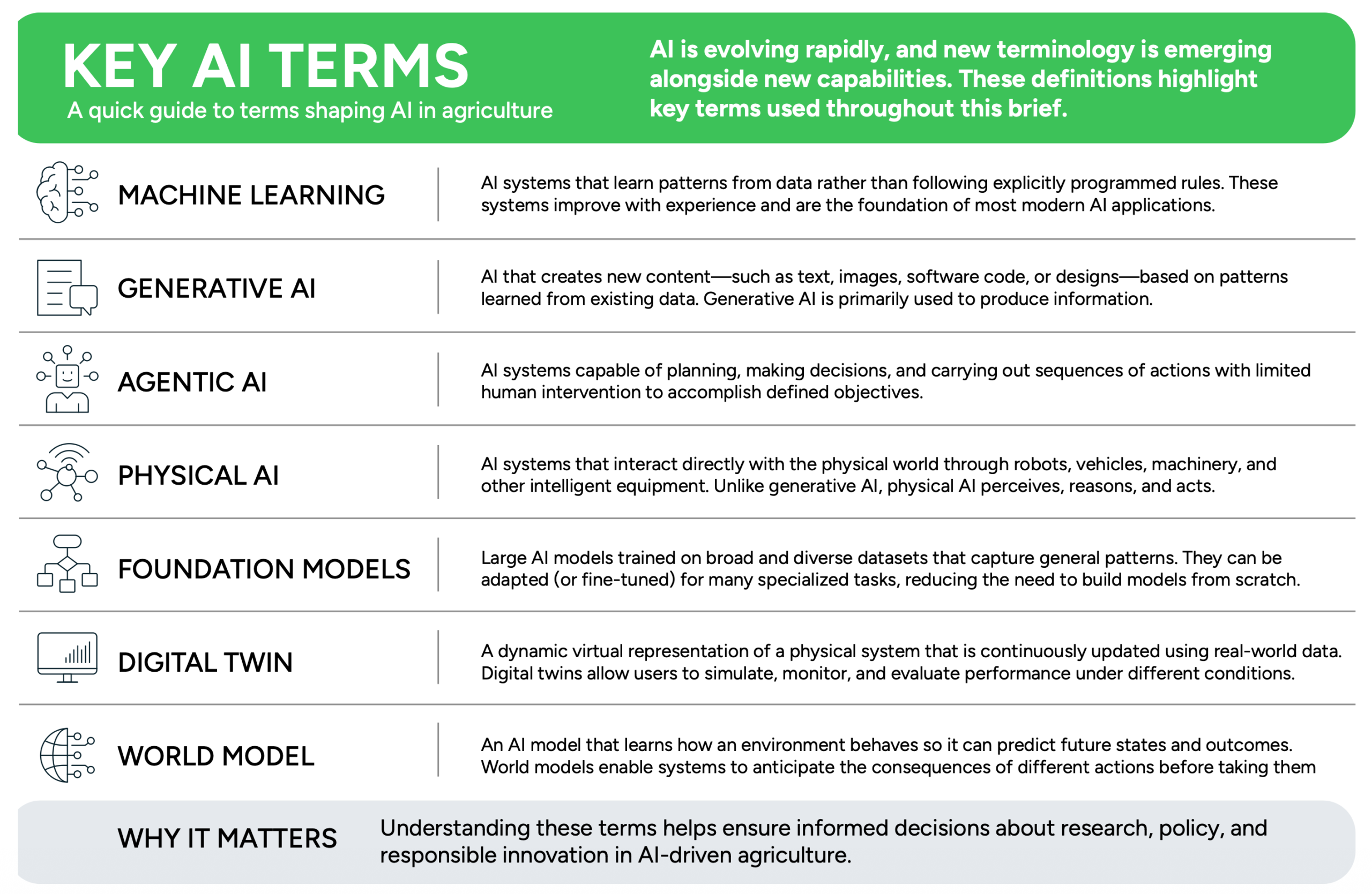
Figure 2. Key AI terminology used throughout this brief.
What the Science Shows
A synthesis of current peer-reviewed research on AI across the U.S. food system — where it stands today, where it is headed, and what policy must address.
Where AI Is Creating Value — Today
AI is becoming embedded throughout the agricultural value chain — from crop and livestock production to food processing, transportation, and natural resource management. In each sector, the objective is the same: enabling people and machines to perceive conditions, make better decisions, and increasingly take physical action.
Computer vision and machine learning now enable equipment to distinguish crops from weeds, identify disease symptoms before they are readily apparent, estimate crop maturity and yield, and guide autonomous equipment in real time. These technologies change the fundamental unit of management from the field or zone to the square meter or even the individual plant.
John Deere's See & Spray system uses AI to selectively apply herbicides only where weeds are detected. A cotton producer spraying a 100-acre field no longer applies the same treatment to every acre — the AI-enabled sprayer identifies individual weeds while traveling at field speed and applies herbicide only where individual weeds are detected. The producer is no longer managing a 100-acre field; the AI system is making millions of plant-level decisions as it crosses that field. Carbon Robotics' laser-weeding system identifies and destroys individual weeds without chemical applications. Robotic systems are also beginning to thin blossoms, prune branches, and harvest high-value specialty crops based on real-time fruit maturity assessments.
Unlike crops, livestock are mobile biological systems whose health and welfare depend on timely observation. AI enables continuous monitoring through computer vision, wearable sensors, automated feeding systems, and acoustic monitoring — detecting subtle behavioral or physiological changes associated with respiratory disease, lameness, heat stress, estrus, or parturition before they become readily apparent.
AI may analyze thousands of coughs by hogs each day in a commercial swine facility. Rather than waiting for workers to recognize obvious clinical symptoms, acoustic sensors coupled with AI models can detect subtle changes associated with respiratory disease days earlier, allowing more targeted intervention and potentially reducing unnecessary antimicrobial treatments. Similar approaches are being developed for dairy cattle, poultry, and other livestock systems.
Some of the greatest economic value from AI is created after products leave the farm — through grading and inspection to certify high-value products, minimizing physical loss, extending shelf life, and converting raw produce into higher-value marketable goods. AI is increasingly integrated into these activities as well as logistics and inventory management.
A packing facility processing hundreds of thousands of apples each day no longer relies on statistical sampling. AI evaluates every individual apple in milliseconds for size, color, bruising, defects, and — in some systems — internal quality. Products are directed to the highest-value market while defective fruit are removed before reaching consumers. AI changes quality control from sampling to comprehensive inspection.
AI is increasingly shifting resource management from reactive to predictive by integrating information from satellites, weather networks, soil sensors, stream gauges, and other environmental monitoring systems. Applications include harmful algal bloom prediction, wildfire risk assessment, drought assessment, irrigation scheduling, watershed management, invasive species detection, and conservation planning.
Many of these capabilities depend heavily on publicly supported environmental observations. Policy questions therefore extend beyond AI algorithms to the long-term investment required to sustain the environmental data infrastructure on which these systems depend.
AI Maturity Across the Value Chain
The maturity of AI capabilities varies substantially by sector and application. This matrix reflects the current state of deployment — not future potential.
| Sector | Perception & Analysis | Decision Support | Physical Action |
|---|---|---|---|
| Crop Production | Commercially Deployed | Commercially Deployed | Deployed / Emerging |
| Animal Production | Commercially Deployed | Commercially Deployed | Emerging |
| Food & Postharvest | Commercially Deployed | Commercially Deployed | Commercially Deployed |
| Natural Resources | Commercially Deployed | Deployed / Emerging | Early / Emerging |
Commercially Deployed — available and in operational use Emerging — limited operational deployment or advanced development Early — primarily research and development
AI will become an increasingly important part of U.S. agriculture. Thoughtful policy can help ensure that its benefits are broadly shared while strengthening agricultural productivity, resilience, competitiveness, and responsible stewardship of natural resources.
How AI's Role Is Evolving
AI is changing the role of computing within agriculture. Earlier generations of digital technologies primarily collected, stored, and communicated information. AI analyzes that information, identifies patterns, predicts outcomes, and increasingly directs physical operations.
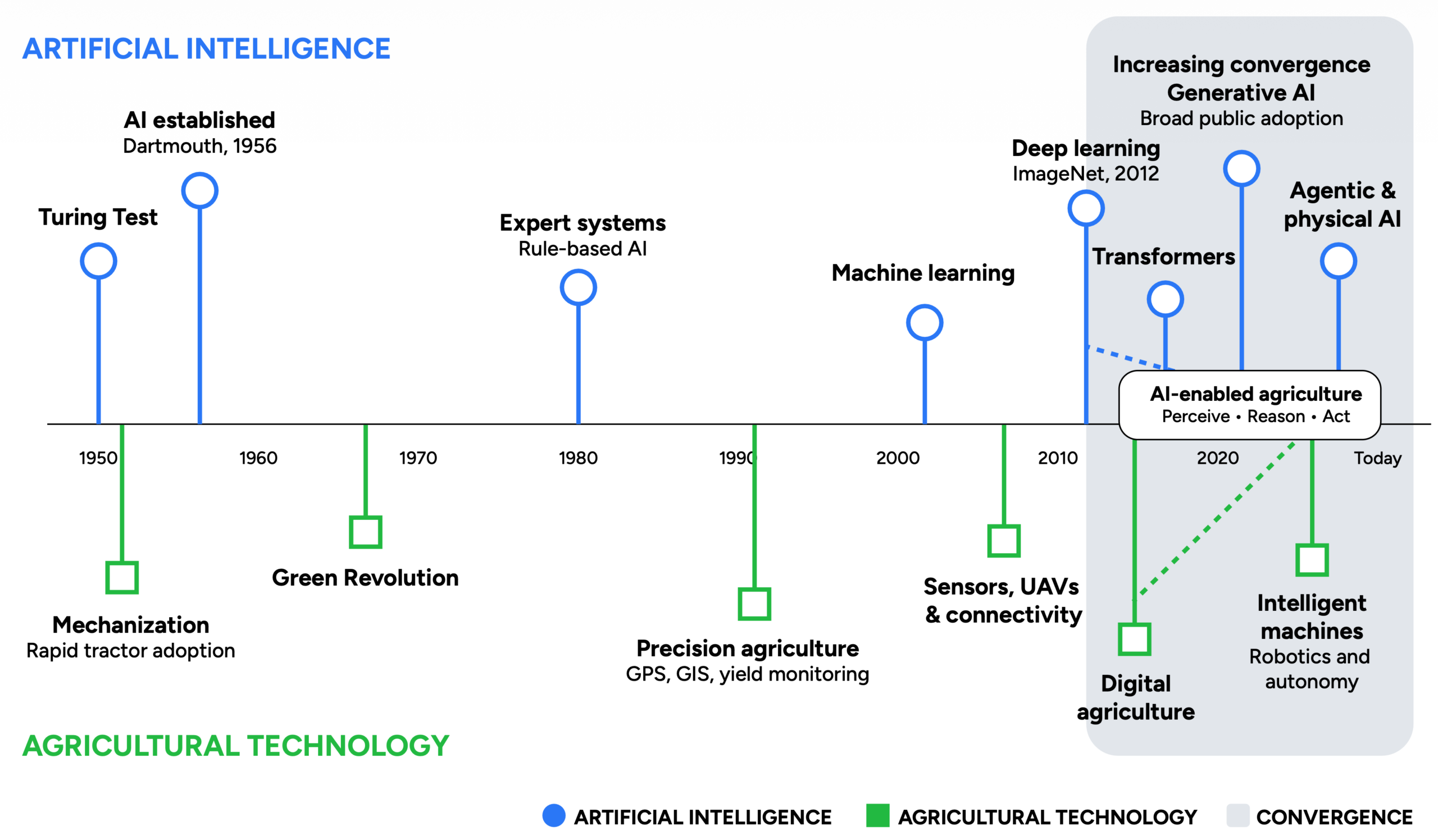
Figure 3. Convergence of artificial intelligence and agricultural technology, 1950 to today.
From Data
Agriculture has become one of the world's most data-intensive industries, generating information continuously from machinery, weather stations, satellites, soil sensors, livestock monitoring systems, laboratory analyses, and supply chains. AI integrates diverse sources to identify relationships, detect anomalies, and recommend management actions impossible for humans to produce consistently at scale.
To Decisions
Generative AI has further expanded access. Producers and advisors increasingly interact with sophisticated analytical tools through natural language rather than specialized software, lowering technical barriers. Decision support is becoming a routine feature of farm management rather than a specialized capability available only to large operations or technical experts.
To Action
AI increasingly closes the loop between perception and execution. Information systems become operational systems. Decisions that once required continuous human interpretation can increasingly be translated into physical actions performed by intelligent machines under human supervision — what the brief terms "physical AI."
Physical AI: Agriculture as the Proving Ground
As AI becomes integrated with robotics, sensors, and autonomous equipment, agriculture is moving toward physical AI — intelligent systems capable of perceiving, reasoning, and acting in complex environments. Agricultural systems are dynamic and unrestrained rather than controlled like a factory. Crops grow continuously. Insects and diseases come unexpectedly. Animals behave unpredictably. Weather changes hourly. Soil conditions vary across landscapes.
Using a physical AI system to pick a marketable peach requires more than simply recognizing where the fruit is. The system must estimate ripeness, determine whether the fruit can be reached without damaging nearby branches, plan a collision-free path, adjust its grip as the fruit moves, and respond if wind or branch motion changes unexpectedly. Agriculture is one of the world's most demanding proving grounds for physical AI, because success depends on integrating perception, reasoning, and action in dynamic biological environments — all without direct human intervention.
AI as a Force Multiplier
The long-term benefit of AI lies in expanding human analytical capability — interpreting more information, recognizing emerging problems sooner, evaluating more management alternatives, and automating dull, dirty, dangerous, and drudgerous tasks. The resulting workforce will require different skills rather than fewer skills. Producers, crop advisers, veterinarians, food processors, engineers, and natural resource managers will continue making the decisions that define successful agricultural enterprises — but increasingly with intelligent systems extending their reach.
The Ecosystem AI Needs to Succeed
AI systems do not succeed at scale simply because algorithms become more sophisticated. They succeed because the surrounding ecosystem enables reliable deployment in real-world applications. For agriculture, that ecosystem includes high-quality data, robust digital infrastructure, interoperable technologies, a skilled workforce, and institutions capable of evaluating and supporting AI applications.
Data Infrastructure
Agricultural AI depends on data that are accurate, representative, and scientifically credible. Unlike internet applications where billions of users continuously generate training data, agricultural data are often expensive to collect, geographically dispersed, and highly variable across crops, production systems, climates, and management practices. Images of crop diseases, machinery operations, animal behavior, soil conditions, and food quality frequently require expert annotation before they become useful for training AI systems.
Long-term environmental observations, benchmark datasets, standardized metadata, and open evaluation protocols function as research infrastructure that can accelerate innovation across universities, government agencies, and industry. USDA has long supported shared scientific resources such as germplasm collections, weather observations, soil surveys, and genomic databases. Comparable investments in agricultural AI datasets and evaluation frameworks could reduce duplication of effort, improve scientific reproducibility, and lower barriers to innovation.
Digital Infrastructure
Training large AI models and providing cloud-based services require immense computing capacity. In addition to cloud computing, reliable broadband communications, edge computing, and positioning systems enable AI to operate in real agricultural environments — where connectivity is intermittent or non-existent, environmental conditions are harsh, and computational decisions must often be made locally with minimal communication delays. Infrastructure decisions made today will influence the pace and geographic distribution of AI adoption for many years.
Interoperability, Standards, and Trust
Agricultural producers routinely operate equipment, software, and services supplied by multiple manufacturers. AI will provide the greatest long-term value if these systems exchange information reliably and operate together safely. Open standards, interoperable data formats, and transparent evaluation methods promote competition, reduce technology lock-in, and allow producers greater flexibility when adopting new technologies.
A producer who owns tractors from one manufacturer, sprayers from another, irrigation systems from a third, and agronomic software from yet another provider faces a real problem: if these systems cannot exchange information, or if operational data cannot be transferred between platforms, adopting AI becomes more difficult and more expensive. Interoperability therefore influences not only convenience but also competition, innovation, and producer choice.
Workforce and Institutions
AI is changing the skills required throughout agriculture rather than reducing the importance of human expertise. Future agricultural professionals will increasingly supervise intelligent equipment, interpret AI-generated recommendations, evaluate system performance, and integrate digital technologies into routine operations — responsibilities that require knowledge combining agricultural science with data science, engineering, and computer science. Land-grant universities, Extension, community colleges, and workforce-development programs will play central roles in preparing this workforce.
Key Policy Considerations
Many decisions shaping agricultural AI over the next decade will not concern AI algorithms themselves. They will involve investments in infrastructure, research priorities, workforce development, data governance, energy systems, and regulatory frameworks.
Agricultural Data as National Research Infrastructure
High-quality agricultural datasets are becoming as important to AI innovation as experimental farms, weather observations, and genomic databases have been to previous generations of agricultural research. Yet many of the datasets needed to develop and evaluate AI systems remain fragmented, proprietary, or unavailable for scientific benchmarking.
USDA and other agencies have an opportunity to expand the research infrastructure supporting agricultural AI by investing in benchmark datasets, standardized evaluation protocols, long-term environmental observations, and data stewardship. Such investments would improve scientific reproducibility, lower barriers to innovation, and enable more objective evaluation of competing AI technologies.
AI Infrastructure Is Agricultural Infrastructure
The rapid expansion of AI-based computing is creating new demands for electricity, water, land, and transmission capacity. Increasingly, data centers are being proposed in rural communities where land is available and electrical infrastructure may be favorable — creating economic development opportunities but also important tradeoffs.
A rural electric cooperative must accommodate growing electrical demand from expanded agricultural irrigation while also receiving a request to serve a large AI data center. Both projects promise economic benefits, but both require transmission capacity that is already constrained. Data-center demand for freshwater may be reduced through closed-loop cooling systems, use of reclaimed or non-potable water, and cooling technologies that reduce evaporative water losses. Agriculture may also become an energy partner — hosting renewable generation, battery storage, or small modular reactors that improve resilience for both agricultural operations and AI infrastructure.
Competition, Interoperability, and Producer Choice
AI is increasingly delivered through integrated digital platforms bundling machinery, software, cloud computing, agronomic services, and operational data. These ecosystems can accelerate innovation but also raise questions about interoperability, data portability, market concentration, and producer choice.
Public policies that encourage open standards, transparent interfaces, and interoperable data systems can help preserve competition while allowing producers to adopt technologies from multiple providers. Maintaining producer confidence will also require clear expectations regarding data ownership, cybersecurity, privacy, and the responsible use of operational information generated on farms.
Preparing the Agricultural Workforce
AI will influence nearly every agricultural profession — producers, laborers, consultants, veterinarians, engineers, food scientists, Extension specialists, equipment technicians, and natural resource managers. The greatest workforce challenge is unlikely to be widespread displacement. Instead, it will be preparing the workforce to supervise, maintain, and repair increasingly capable intelligent systems, interpret AI-generated recommendations, and integrate digital technologies into routine operations.
Land-grant universities, community colleges, Extension, and industry partnerships will play central roles. Future graduates will require greater fluency in data science, AI, robotics, cybersecurity, and systems integration while maintaining strong foundations in agricultural sciences.
Validation, Standards, and Cybersecurity for Autonomous Systems
As AI assumes greater responsibility for controlling physical equipment, policy must address machines that operate under human supervision rather than direct human control. Existing regulatory frameworks were largely developed for machines operated directly by humans. Increasing levels of machine autonomy will require a corresponding evolution in standards, testing methodologies, and public confidence.
Independent validation, rigorous field testing, cybersecurity, and clear performance standards will be increasingly important as AI assumes greater responsibility for operational decisions and autonomous equipment becomes more widespread across agricultural production.
Looking Forward
AI has moved from a promising research topic to a foundational technology reshaping agriculture and the food system. How it develops from here depends on the institutions, investments, and policy choices made in the years immediately ahead.
AI has moved beyond a promising research topic to a foundational technology that is reshaping agriculture and the broader food system. It is expanding the ability of producers, processors, researchers, and natural resource managers to interpret information, improve decisions, and increasingly automate complex physical tasks. Its influence extends well beyond production agriculture to food processing, supply chains, environmental stewardship, and scientific discovery.
Like previous technological revolutions, the long-term impact of AI will depend not only on technological innovation but also on the institutions, infrastructure, and people that support its adoption. Investments in research, data resources, education, computing, connectivity, and standards have historically accelerated agricultural innovation while ensuring that benefits extend broadly across society.
The policy choices made during the next few years will help determine whether AI develops as a collection of isolated technologies or as an integrated capability that benefits producers, consumers, rural communities, and the environment. The opportunity extends beyond developing more capable AI systems. It lies in building the research infrastructure, data resources, educational programs, governance frameworks, and public-private partnerships needed to ensure that AI strengthens American agriculture while preserving producer choice, encouraging innovation, and promoting responsible stewardship of natural resources.
No single organization possesses the data, expertise, infrastructure, and operational experience needed to develop and deploy agricultural AI at scale. Continued progress will depend on partnerships among producers, technology developers, academic institutions, government agencies, conservation partners, and commodity organizations. The nation's land-grant institutions can play important roles in developing new technologies, evaluating their performance under agricultural conditions, and preparing the workforce needed to support their adoption.
Hear It Directly from the Author
Alex Thomasson presents the brief's key findings and takes your questions live.
Can't attend live? Register to receive the recording.

Download the Brief
Peer-reviewed, nonpartisan, and freely available. CAST policy briefs make agricultural science accessible to policymakers, the media, and the public.
Policy Brief
Complete peer-reviewed paper with all findings, data, and citations. For researchers, policymakers, and technical readers.
Download PDFExecutive Summary
Two-page summary of key findings and policy considerations. Designed for Hill staff, media, and non-specialist audiences.
Download SummaryCite This Work
Peer-reviewed and DOI-assigned through CAST Publications. Use the DOI for citation in academic and policy documents.
doi.org/10.62300/f5ts2461