
Cyanobacterial harmful algal blooms, or cyanoHABs, are becoming more frequent, more intense and longer-lasting in many regions. They can produce toxins that harm people, pets, livestock and wildlife, and they disrupt drinking water supplies, irrigation, livestock watering, aquaculture and recreation.
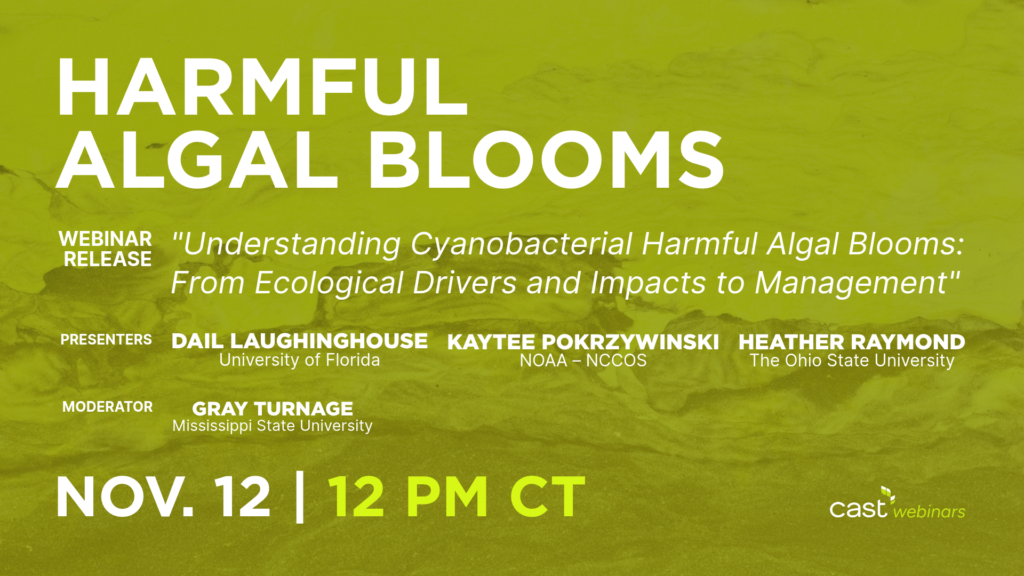
On Nov. 12, CAST will release a new paper, Understanding Cyanobacterial Harmful Algal Blooms: From Ecological Drivers and Impacts to Management, with a live webinar featuring its authors. They will discuss what drives blooms, how cyanotoxins move into water, crops, livestock and fish, how blooms are detected and forecast, and which management strategies work in which settings.
The paper’s central management message is that no single fix works everywhere. Lasting control depends on reducing nutrient inputs over the long term, paired with short-term interventions matched to the site, the bloom and how the water is used.
Presenters
- Dail Laughinghouse, associate professor of applied phycology, University of Florida IFAS
- Kaytee Pokrzywinski, research marine biologist, NOAA National Centers for Coastal Ocean Science
- Heather Raymond, director, Water Quality Initiative, The Ohio State University College of Food, Agricultural, and Environmental Sciences
Moderator
- Gray Turnage, Geosystems Research Institute, Mississippi State University
The paper was chaired by Lyn A. Gettys and Gray Turnage, with authors H. Dail Laughinghouse IV, Kaytee L. Pokrzywinski, West M. Bishop, Heather A. Raymond, Triantafyllos Kaloudis, Alina Gialleli, Kevin G. Sellner, Gregory L. Boyer, Jessica A. S. Moretto and David E. Berthold.
Thursday, Nov. 12, 2026 | Noon–1 p.m. CT | Free and open to all