
Release Webinar
Hear From the Authors
Authors Dail Laughinghouse, Kaytee Pokrzywinski, Heather Raymond and West Bishop present the paper's findings. Co-chair Gray Turnage moderates. Thursday, Nov. 12, 2026, noon–1 p.m. CT. Free and open to all.
Thursday, Nov. 12, 2026 · Noon–1 p.m. CT (1–2 p.m. ET). A recording will be posted here after the event.
An Expanding Threat to Water and Agriculture
The paper gives agricultural, livestock and aquaculture stakeholders a foundation in cyanobacteria biology, environmental drivers, health and economic impacts, and evidence-based management.
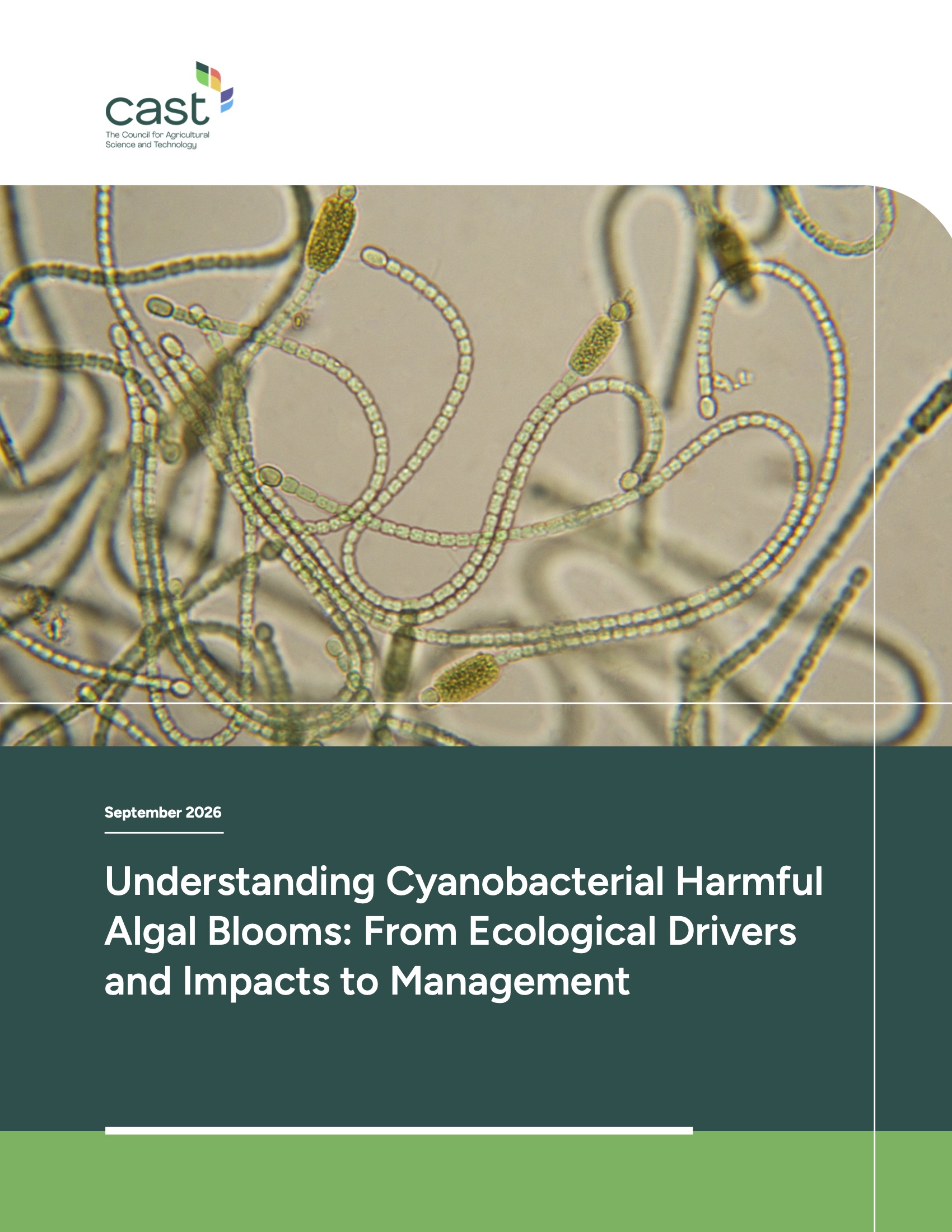
Cyanobacteria, commonly known as blue-green algae, are among Earth's oldest microbial groups. When conditions favor rapid growth, certain species form cyanobacterial harmful algal blooms, or cyanoHABs, that threaten irrigation, livestock watering, aquaculture and public health.
These blooms are increasing in frequency, intensity and duration in many regions, driven by nutrient enrichment from agricultural and urban runoff, altered hydrology and changing weather patterns. Better monitoring explains part of the rise, but the authors note broad scientific consensus that blooms are genuinely becoming more severe. State advisories reported to the U.S. Environmental Protection Agency have risen since systematic tracking began in 2015.
Many cyanobacteria produce potent toxins that can cause acute and chronic illness in people and animals. Others release compounds that give water and farmed fish an earthy, musty taste. Because no single intervention works everywhere, the authors call for site-specific management that matches the method to the water body, the bloom and how the water is used.
What Agriculture Needs to Know
Five points from the paper for producers, water managers and policymakers.
What Drives Blooms
CyanoHABs are favored by the convergence of high nutrient availability, warm and stratified water, and physiological traits that let cyanobacteria outcompete other algae.
Forests and other native landscapes contribute little nitrogen and phosphorus, while agriculture and urban development have greatly increased loading into water bodies. Agricultural runoff remains a major source, and suburban and urban runoff contributions are rising. Advances in wastewater treatment have reduced discharges into many water resources.
Blooms are most common during warm, calm summer periods. Thermal stratification lets competing algae settle out of the surface layer and creates low-oxygen conditions in deeper water that release nitrogen and phosphorus from sediments.
Many cyanobacteria regulate their buoyancy with gas vesicles, rising to the surface for light by day and sinking to nutrient-rich layers at night. Some fix atmospheric nitrogen, store excess phosphorus, shade out competitors, resist grazing and survive winter as resting cells that can remain viable for decades.
Reducing nitrogen and phosphorus inputs remains the most effective long-term strategy for prevention. Where best management practices are not fully implemented or diffuse inputs continue, short-term interventions such as artificial mixing or algaecides are often needed.
Benthic Blooms: An Emerging Concern
Benthic cyanobacteria grow on or near the bottom of a water body. They are less studied than floating species because they are harder to monitor at depth, yet they form dense mats that harm public and ecosystem health. Toxic benthic blooms have been associated with dog deaths in the U.S. and abroad, but health advisories for them are rare because monitoring and posting standards are limited. When mats detach, toxins can disperse freely from floating clumps.
Toxins and Off-Flavors
More than 300 cyanobacterial toxins are known. Because the number of toxic species and toxins is likely underestimated, the authors advise treating cyanobacteria as potentially toxic.
| Toxin Class | Known Variants | How It Acts | Health Effects |
|---|---|---|---|
| Microcystins | 256+ | Liver toxin; inhibits protein phosphatases | Gastrointestinal illness, liver inflammation, hemorrhage and liver failure leading to death; pneumonia; dermatitis |
| Nodularins | 10 | Liver toxin; inhibits protein phosphatases | Same as microcystins |
| Cylindrospermopsins | 5 | Liver, cell and nerve toxin | Gastrointestinal illness, liver inflammation and hemorrhage, pneumonia, dermatitis |
| Anatoxins | 10 | Nerve toxin; mimics acetylcholine | Tingling, numbness, drowsiness, incoherent speech, respiratory paralysis leading to death |
| Guanitoxin | 1 | Nerve toxin; inhibits acetylcholinesterase | Excessive salivation, convulsions, respiratory paralysis leading to death |
| Saxitoxins | 84+ | Nerve toxin; blocks sodium channels | Tingling, numbness, drowsiness, incoherent speech, respiratory paralysis leading to death |
Summarized from Table 1 of the paper, which also lists the cyanobacteria genera known to produce each toxin.
Whether a bloom is toxic depends on three things: a toxin-producing strain must be present, the genes that make the toxin must be switched on, and the bloom must reach enough biomass for toxins to be measurable. For microcystins, the best-studied toxins, higher nitrogen availability generally increases production, and warmer temperatures may favor toxic strains over nontoxic ones.
Geosmin and 2-methylisoborneol (MIB) give water an earthy or musty flavor that people can detect at extremely low concentrations. Most are not known to cause health concerns, but conventional water treatment largely fails to remove them, and they make farmed fish unmarketable when they accumulate in flesh.
Finding Blooms Before They Cause Harm
Tools range from microscopy and pigment sensors to molecular tests and satellites. Each has strengths and limits, and only toxin analysis can confirm whether a bloom is toxic.
Pigments
Chlorophyll-a sensors are well established but cannot tell cyanobacteria from other algae. Phycocyanin and phycoerythrin are more specific, and in-situ and remote sensors can map bloom extent over thousands of square kilometers.
Cell counts
Manual or semi-automated counting can identify genera known to produce toxins, but it is time- and labor-intensive and requires skilled analysts.
Molecular tests
qPCR assays for toxin-production genes can flag the potential for toxins days or weeks before toxins are detectable, giving managers early warning. A gene's presence does not guarantee toxin production.
Toxin analysis
ELISA kits are fast and inexpensive; liquid chromatography–mass spectrometry gives the most precise results for individual variants. For saxitoxins, ELISA results should be confirmed with liquid chromatography–based methods, because ELISA can underestimate totals in some regions. Detection is complicated by the limited availability of certified reference standards for most variants.
Satellites and forecasts
The interagency Cyanobacteria Assessment Network (CyAN) monitors inland waters more than 1 kilometer wide, and NOAA's National Centers for Coastal Ocean Science runs an operational Lake Erie HAB Forecast. Forecasts for smaller water bodies are now being explored as higher-resolution satellite data become available.
From Drinking Water to the Dinner Plate
People, livestock, pets and wildlife can be exposed through ingestion, contact or inhalation, and crops can take up toxins from irrigation water.
Livestock deaths from cyanotoxins, mainly from drinking contaminated water, have been documented routinely for decades. Acute deaths can follow heavy exposure to surface scums, but chronic exposure without visible scums can also kill. Toxins from benthic cyanobacteria have killed cattle even in nutrient-poor alpine streams.
Irrigation with contaminated water can reduce seed germination, inhibit plant growth and lower yields. Studies cited in the paper found microcystins in lettuce leaves above the World Health Organization's tolerable daily intake, and in carrots and radishes irrigated with contaminated water. In 2016, the Utah Department of Agriculture advised farmers and ranchers not to use Utah Lake water for irrigation or livestock after a bloom was detected.
Microcystins accumulate in fish, mostly in livers and viscera. Taste and odor compounds absorbed through gills and skin cause off-flavors that lower prices or make fish unsellable.
Symptoms range from skin, eye and throat irritation and gastrointestinal illness to liver or kidney damage, neurological effects and death. Aerosols from wave action, boat wakes or spray irrigation are an understudied exposure route, including for agricultural workers irrigating with contaminated water.
Toxins can harm fish and zooplankton and move up the food chain to birds and mammals. Mats clog intake pipes and smother native vegetation, and bloom cycles cause large swings in oxygen and pH that typically reduce biodiversity.
A Patchwork of Thresholds
There are no federal maximum contaminant levels for cyanotoxins in drinking water. EPA's health advisories are non-regulatory, and state thresholds vary considerably.
| Guideline | Microcystins | Cylindrospermopsin |
|---|---|---|
| Drinking water, adult (EPA health advisory, 2015) | 1.6 µg/L | 3.0 µg/L |
| Drinking water, child (EPA health advisory, 2015) | 0.3 µg/L | 0.7 µg/L |
| Recreational water (EPA, 2019) | 8 µg/L | 15 µg/L |
From Table 2 of the paper, which also lists World Health Organization values, state ranges and the FDA limit for saxitoxins in shellfish. EPA's health advisories apply to a 10-day exposure. Verify thresholds with your state, as values vary.
The agricultural, water management, and public health communities cannot wait for perfect science to act—the tools and knowledge to reduce cyanoHAB impacts are available now.
The Cost of Blooms
Conservative estimates put the annual U.S. cost of cyanoHABs and associated eutrophication at $2.2 billion to $4.6 billion. Those estimates are more than 15 years old and likely understate current losses.
The main costs come from public health, lost recreation and tourism, impaired fishing, and monitoring and management. Water utilities face intensive treatment, advanced technology and, at times, plant shutdowns and drinking water advisories. Large systems can spend hundreds of thousands of dollars a year on activated carbon to remove taste and odor compounds.
A bloom in Lake Erie contaminated the drinking water supply of 400,000 Toledo, Ohio, residents for three days. It cost the city an estimated $65 million in economic impacts, plus $53 million in water treatment upgrades.
Losses of more than $70 million a year are projected in the catfish aquaculture industry alone from bloom-caused off-flavor. Modeling suggests a 10% improvement in water quality could raise U.S. property values by $6 billion to $9 billion.
Proactive and Reactive Strategies
Proactive strategies work over years to decades to prevent blooms. Reactive strategies act within days to weeks on active blooms but usually need repeating. The authors find that combining both is the most effective approach.
| Approach | Proactive (Long-Term) | Reactive (Short-Term) |
|---|---|---|
| Chemical | Reduced nutrient loading, nutrient inactivation, phosphorus-binding compounds, colorants | Algaecides, colorants, enzymes, flocculants and coagulants, oxidizers, polymers, plant and bacteria extracts, toxin neutralization |
| Physical / Mechanical | Hypolimnetic aeration, artificial mixing, barriers, watershed restoration, stormwater management, constructed wetlands, buffer zones, dredging | Raking, skimming, filtration, shade cloth, flushing, ultrasonic devices, ultraviolet light, dissolved air flotation, ozonation, mechanical harvesting |
| Biological | Food web biomanipulation, bioremediation microbes, integrated aquaculture, native plant establishment, ecosystem restoration, fish and invertebrates, turf scrubbers, floating islands | Algaecidal bacteria, viruses and parasites; biological flocculation |
Adapted from Table 3 of the paper. Substances used to control algae or cyanobacteria in the United States must be registered by EPA under the Federal Insecticide, Fungicide, and Rodenticide Act (FIFRA).
Long-Term Prevention
Reducing nutrient loading is critical. With rising fertilizer costs and growing attention to soil health, strategies that improve nutrient-use efficiency while reducing losses are key. Constructed wetlands, riparian buffer zones and in-lake phosphorus inactivation can cut nutrient supplies, though nonpoint-source reductions can take years to decades and often need policy change and broad funding.
Short-Term Control
Algaecides are routinely and effectively used but require federal approvals and state or local permits. Treating early in a bloom reduces oxygen loss and toxin release and requires less product. Flocculants, emerging tools such as nanobubble ozone, and skimming systems can also help, but performance varies with the site and bloom.
Posting advisories and closing water access reduces some exposure, but leaving a bloom untreated can increase the amount and duration of toxin exposure and seed future blooms through overwintering cells.
When Rules Slow the Response
Even when the right strategy has been identified, permitting can delay treatment, sometimes by months or years.
Under FIFRA, algaecides must undergo extensive registration before field use, with preliminary classification decisions alone taking more than five months. The National Pollutant Discharge Elimination System (NPDES) requires separate permits for chemical applications in water. Physical and mechanical methods such as aeration and harvesting face fewer barriers, but the authors stress that a simpler permitting path does not make a method more effective or appropriate.
For agriculture, more than 15,500 concentrated animal feeding operations need NPDES permits and nutrient management plans. Food safety rules add tolerance requirements for treatment residues in water used for livestock, irrigation or aquaculture, and compliance costs in aquaculture can reach millions of dollars a year. These delays fall hardest on smaller operations without regulatory staff.
Seven Priorities for Research and Investment
The authors call for sustained collaboration among scientists, water managers, agricultural producers, regulators and policymakers, focused on the following.
Sustain and Expand CyAN
Continue support for the Cyanobacteria Assessment Network and expand it to smaller lakes and rivers as higher-resolution satellite, drone and aerial data become available.
Develop Low-Cost Sensors
Support applied research on new or improved low-cost bloom and toxin sensors for pond and lake managers and early warning networks.
Improve Predictive Models
Forecast bloom location, intensity, toxicity and transport over days, with longer projections over weeks to seasons, and invest in monitoring for drinking water sources and heavily used recreation areas.
Reduce Nutrient Losses
Continue and expand support for long-term nutrient-use efficiency and nutrient loss reduction strategies.
Field-Test Emerging Controls
Expand research, development and field testing of control strategies that are scalable, acceptable and effective with negligible impacts on beneficial species or human uses.
Standardize Benthic Monitoring
Develop standard protocols for monitoring benthic and periphytic blooms and support the description of new species and toxins.
Revise Toxicity Levels
Determine or revise acute and chronic toxicity levels of cyanotoxins for animals, including humans, and in crops, food, food supplements and aerosols.
From the Farm Field to Federal Policy
The increasing frequency and severity of cyanoHABs mean that proactive and reactive management must become standard practice rather than crisis response.
Several federal programs already support development and testing of control strategies, including the U.S. Army Corps of Engineers HAB Demonstration Program, NOAA's Prevention, Control, and Monitoring program and the HAB Control Technologies Initiative. The authors call for sustained and expanded investment to move the most promising strategies from demonstration to operational use.
Before emerging techniques are used widely, they need comprehensive assessment of efficacy, ecotoxicity, social acceptance, cost, scalability and operational feasibility. But the tools and knowledge to reduce bloom impacts exist now, and applying them requires commitment, coordination and sustained resources at every level, from the farm field to federal policy.
Disclaimer: The findings, opinions and conclusions expressed in this paper are those of the authors and do not necessarily reflect the views of CAST or the authors' respective institutions or agencies. Any mention of trade names, commercial products, processes or services is for informational purposes only and does not constitute or imply endorsement or recommendation by the authors, their agencies, institutions or CAST.
Download the Paper
Freely available. CAST papers make agricultural science accessible to policymakers, the media and the public.
Understanding Cyanobacterial Harmful Algal Blooms
Complete paper with bloom biology, toxin tables, health guidelines, management options and citations. For researchers, water managers, policymakers and technical readers.
Read the PaperRelease Webinar
Authors Dail Laughinghouse, Kaytee Pokrzywinski, Heather Raymond and West Bishop present the paper's findings, moderated by Gray Turnage. Thursday, Nov. 12, 2026.
Register for FreeCite This Work
DOI-assigned through CAST Publications. Use the DOI for citation in academic and policy documents.
10.62300/m7xd1n72