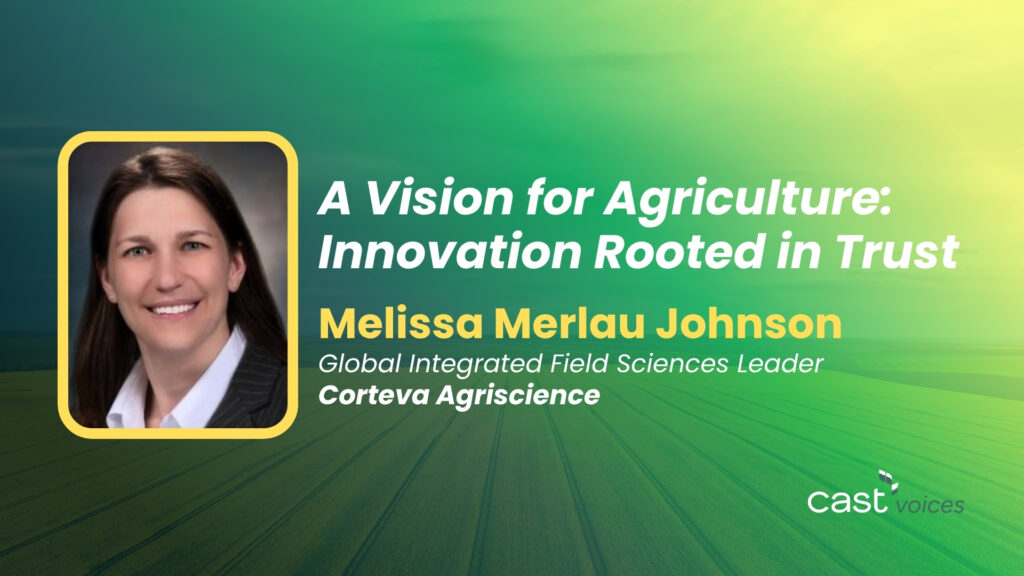

By Melissa Merlau Johnson
Global Integrated Field Sciences Leader, Corteva Agriscience
From the Green Revolution to today’s breakthroughs in precision tools, gene editing, and biological solutions, agricultural science has leaned into innovation as the primary enabler of the global food supply. For over 50 years, CAST has served as an essential bridge between science and policy, and as we look ahead, our mission must expand to meet a new challenge: bridging the gap between science and the public trust.
To build a future where agricultural innovation thrives, we must work together on a compelling vision and clear priorities. But we must also evolve how we engage. We are living in an era where information is infinite, yet confidence in scientific institutions is often fragmented. As scientists, we often rely on the “Information Deficit Model”—the belief that providing more data will naturally lead to public support. However, communication science teaches us that facts alone rarely change minds. Trust is not a transaction of information. It is built when people see their values reflected in our work. We must move beyond being “experts” and start by being “neighbors.”
We are currently at a historic crossroads. CAST is not just maintaining a legacy; we are evolving to meet modern challenges. The recent creation of the CAST Strategic Advisory Council is the engine behind our most aspirational goal: to evolve into a National Academy of Agriculture. This transition is about more than a title. It is about ensuring that innovation and rigorous science have a leading voice in the policy discussions that shape our food and natural resource systems for decades to come. Yet a National Academy is only as strong as the trust it earns from the people it serves. That trust is built through the human connections we make every day.
Grounding Data in Human Stories
Our vision for the future must be grounded in the human stories behind the opportunities in front of us as a society. When we speak in public forums, we must frame our work through the values we all share:
- Providing Peace of Mind: Innovation and scientific rigor are the silent partners in every healthy meal, ensuring that every parent can provide their family with food that is safe, nutritious, and affordable.
- Stewarding the Environment: We must champion science as the ultimate tool for conservation, proving that we can produce more while leaving the planet better for the next generation.
- Supporting Livelihoods: Our innovations are the tools that keep farming viable across generations. We are protecting the heritage and economic stability of the people who work the land.
We must look beyond the data and become as skilled at human connection as we are at technical innovation. In our writing, professional engagements, and personal interactions, we have the opportunity to:
- Listen First: We cannot solve a heart-level concern with a head-level statistic. We must seek to understand and connect with the values behind the skepticism before offering a solution.
- Tell the Story of Discovery: Let’s not just report findings; let’s share the passion and the breakthrough moments that drive our research.
- Humanize the Expert: We must show up in spaces where science is misunderstood—not just as authorities, but as neighbors who care deeply about our communities and the future of our food system.
The future of agriculture requires both world-class science and world-class empathy. By leading with our shared values—healthy families, a protected environment, and thriving farms—we can ensure that the next century of innovation is as impactful as the last.
___
About Voices of Agriculture
The Voices of Agriculture series is designed to provide a platform for diverse perspectives on issues, trends, and experiences within the agricultural community. These articles aim to foster dialogue, share insights, and highlight the many voices that contribute to the ongoing conversation about agriculture and its future.
Disclaimer
The opinions expressed in this article are solely those of the author. They do not necessarily represent the views, positions, or policies of the Council for Agricultural Science and Technology (CAST). CAST provides this space to encourage thoughtful discussion, but does not endorse any specific viewpoints shared in these pieces.