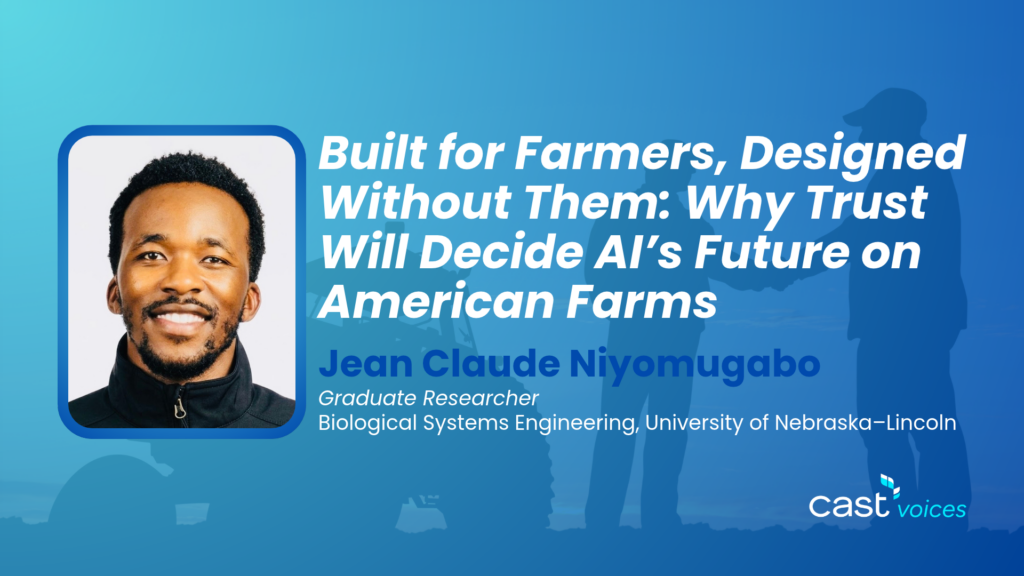

By Jean Claude Niyomugabo
Graduate Researcher, Biological Systems Engineering, University of Nebraska–Lincoln
Most AI tools built for farmers are designed without farmers in mind. I study why that gap exists and what it will take to close it.
AI is no longer a research project on American farms. It is in the combine cab, the satellite image, the crop model, and the chat assistant on a farmer’s phone. Most of the public conversation about these tools focuses on whether they work. That is the right first question, but it is not the last one.
A recommendation can be accurate and still be ignored. On a farm, the person who makes the call is the person who carries the risk: the operating loan, the input bill, the harvest. If they do not trust the advice, the advice does not matter.
Why This Matters Now
Congress is paying attention. The bipartisan FARM AI Act, introduced in both the House and the Senate this year, would direct USDA Extension to educate producers on the adoption and responsible use of AI. That is the right instinct. But education alone will not close a trust gap, and public investment in agricultural AI will only pay off if farmers use what gets built.
The stakes are high. Corn and soybeans are the country’s two largest crops by planted acreage, and the Midwest farms that grow them anchor rural economies, export markets, and the nation’s food supply. The people running those farms are also getting older. USDA’s 2022 Census of Agriculture put the average U.S. producer at 58.1 years old, with 38 percent age 65 or older. The tools we build have to work for experienced farmers making decisions today and for the young people who will take over tomorrow.
We Have Seen This Pattern Before
Precision agriculture is a good reminder. USDA’s Economic Research Service found that auto-steer guidance went from 5.3 percent of planted corn acres in 2001 to 58 percent in 2016. But the same research found that fewer than a quarter of the smallest farms used yield maps, soil maps, variable rate technology, or guidance, while at least half of larger farms did. The technology worked. The adoption was uneven.
AI could repeat that pattern, maybe faster. With auto-steer, a farmer can see the straight rows from the seat. With many AI tools, the farmer gets a number or a sentence and no reason behind it.
Three Questions Farmers Ask
Research on technology adoption keeps pointing to three questions.
Does it work on my farm? A model can be right on average and wrong in one field. Farmers know their soil, their weather, and their history. They discount advice that has not been tested somewhere like home.
Can I see why? Good advisers explain themselves. An agronomist walks the field with you. A tool that cannot show its reasoning, or how sure it is, is asking for trust it has not earned.
Who gets my data? Many AI tools improve by learning from farm data. Farmers want to know what is collected, who sees it, and who benefits. Unclear answers lose trust fast.
What the Land-Grant System Can Do
The goal is not blind trust. People who over-trust automation follow bad advice. People who under-trust it walk away from tools that could help. What we need is trust that matches how well a tool actually performs.
- Test it locally. Extension’s strength has always been local proof. On-farm comparisons between AI recommendations and current practice, run with trusted crop advisers, will do more than any online course.
- Show the reasoning. Tools should explain the basis for a recommendation and how confident they are, and the farmer should always be able to say no.
- Write data terms people can read. Say what is collected, who can access it, and whether it trains the model. The industry already has principles for farm data transparency. AI tools should meet them.
- Build with farmers, not just for them. Bring producers, including small and beginning farmers, in before a tool is scaled, not after.
- Count adoption, not just tools. Success is not how many AI products get funded. It is whether farmers use them, keep using them, and trust what they say.
Listening Before Building
At the University of Nebraska–Lincoln, a land-grant university, I am surveying corn and soybean producers and agriculture students across 11 Midwest states about how they see AI tools: whether they find them useful, whether they trust them, how ready they feel, and what worries them about their data. I include students because they are the next producers, agronomists, and extension educators. How they see AI today will shape how it is used on American farms for decades.
American agriculture has always adopted new technology once farmers could see it work. AI will be no different. If we want it to strengthen farms and rural communities across this country, we have to earn farmers’ trust the way good extension educators always have: one field, one question, and one honest answer at a time. Building that trust is not something to add at the end. It is part of the science.
Share your views. Corn and soybean producers and agriculture students in Nebraska, Iowa, Kansas, Missouri, South Dakota, North Dakota, Minnesota, Illinois, Indiana, Ohio, and Oklahoma can take the survey at go.unl.edu/ai-ag-survey.
About the author
Jean Claude Niyomugabo is a graduate researcher in Biological Systems Engineering at the University of Nebraska–Lincoln, where he studies how Midwest corn and soybean producers perceive, trust, and adopt AI-enabled agricultural technologies. His work connects human-centered AI, digital agriculture, and agricultural communication, and he shares agriculture and technology insights with a community of more than 200,000 people across digital platforms.
Connect: LinkedIn | X
Disclaimer (end of page)
The opinions expressed in this article are solely those of the author. They do not necessarily represent the views, positions, or policies of the Council for Agricultural Science and Technology (CAST). CAST provides this space to encourage thoughtful discussion, but does not endorse any specific viewpoints shared in these pieces.