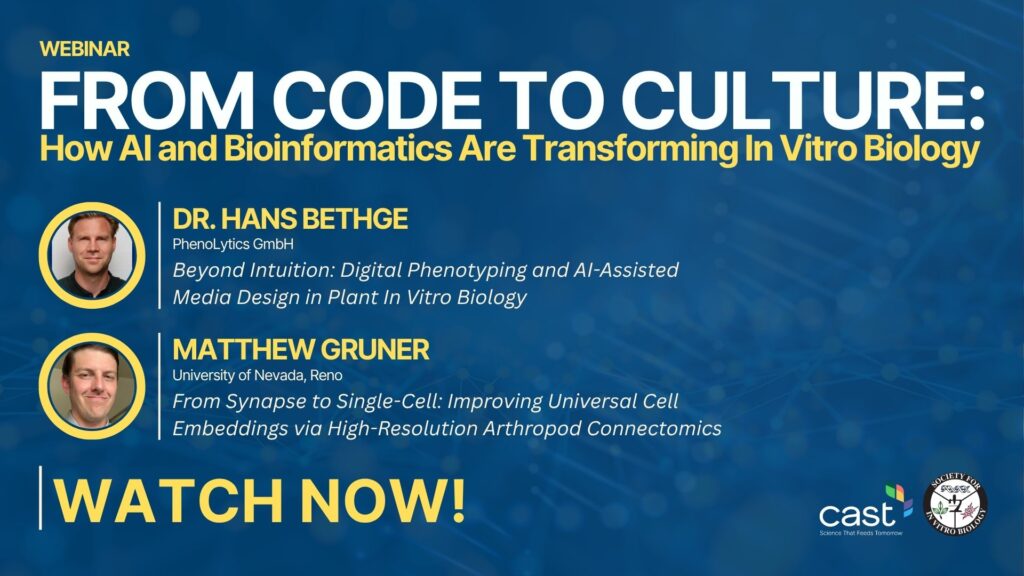

How do you study a biological system you can’t fully see? For researchers working in plant tissue culture and arthropod neuroscience, the answer increasingly involves machine learning and computational tools that detect patterns, classify cells, and map connections at a scale no human observer could match.
This webinar, co-presented by the Council for Agricultural Science and Technology (CAST) and the Society for In Vitro Biology (SIVB), brings together two researchers applying those tools in practice.
Dr. Hans Bethge of PhenoLytics GmbH presents on digital phenotyping and AI-assisted media design in plant tissue culture. His talk covers how imaging technologies — from visible light and fluorescence to CT scanning — enable quantitative, reproducible assessment of developmental traits that were previously evaluated by eye, and introduces ADAM, an open-access platform for data-driven optimization of culture media.
Matthew Gruner of the University of Nevada, Reno, presents on integrating whole-brain connectome data from fruit flies and ants with cross-species single-cell atlases. Working in the laboratory of Dr. Meet Zandawala, Gruner uses tools including SATURN and SCENIC to predict gene regulatory networks and link neuronal connectivity to cellular function across arthropod species.
The session is moderated by Deepika Chauhan of the Society for In Vitro Biology.
Watch the recording: