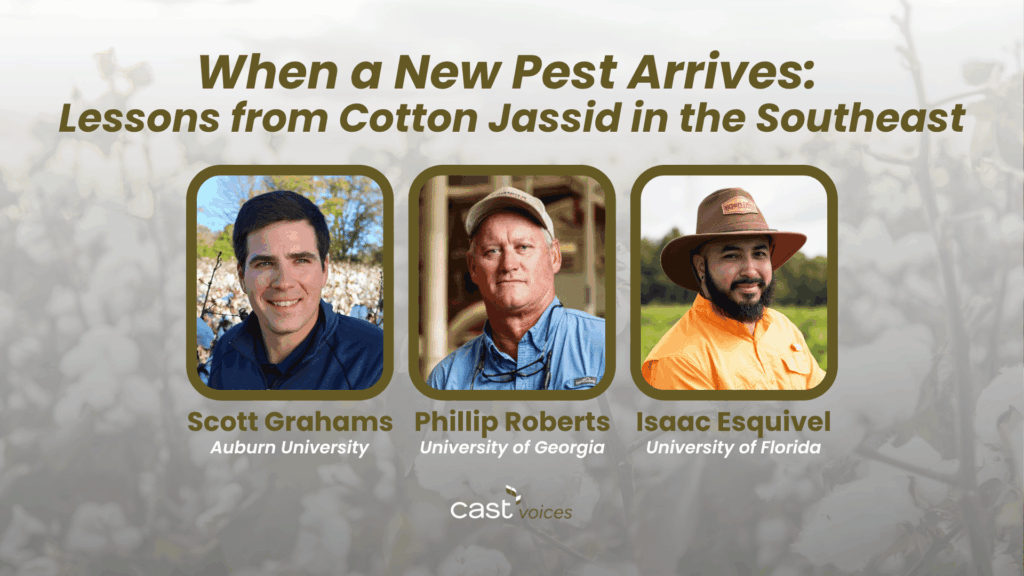

By Scott Graham (Auburn University), Phillip Roberts (University of Georgia), and Isaac Esquivel (University of Florida)
In the fall of 2024, few, if any, cotton producers in the United States had heard of cotton jassid. By the end of the 2025 growing season, the insect had become a major topic of discussion among growers, consultants, Extension personnel, and researchers across much of the Southeast. What had long been recognized as a destructive pest in parts of Asia had suddenly become a new challenge for U.S. cotton production.
The story of cotton jassid is not just about a new insect. It is a story about how agriculture responds when uncertainty arrives.
Whenever a new invasive pest appears, three questions immediately emerge. First, can we control it? Second, does it actually reduce yield and profitability? Third, when should growers intervene to prevent economic loss? Those questions sound simple, but answering them requires research, field observations, and collaboration across a wide network of stakeholders.
Cotton jassid, also known as the two-spot cotton leafhopper, is native to the Indian subcontinent, where it is a major pest of cotton and several vegetable crops. According to regulatory and research observations, the insect was detected in Puerto Rico and the U.S. Virgin Islands in 2023 and then identified in cotton in Florida during late 2024. By the end of the 2025 season, it had been observed across nearly every cotton-producing county in Alabama, Florida, Georgia, and South Carolina, with detections extending into several additional cotton-producing states.
What made cotton jassid especially challenging was not just its arrival, but how little was known about its behavior under Southeastern growing conditions. Researchers knew the insect could injure cotton by feeding on leaves and injecting salivary toxins that damage plant tissue. They knew that severe infestations could cause leaf curling, yellowing, reddening of leaf margins, and the characteristic “hopperburn” symptoms reported around the world. What they did not know was how quickly populations would develop, how much yield loss would occur, or how management recommendations from other regions would translate to the southeastern United States.
Those unanswered questions created an immediate need for action.
Across the Southeast, university researchers, Extension specialists, consultants, commodity organizations, and growers worked together to generate information in real time. Existing research trials were modified to include cotton jassid evaluations. New insecticide efficacy studies were established. On-farm observations were combined with experiment station data to determine which products provided reliable control and when applications were needed. Preliminary treatment thresholds were developed and refined as additional information became available.
This response highlights something that often goes unnoticed when agriculture is functioning well. The strength of American agriculture is not just found in productive fields or advanced technology. It is also found in the network of people and institutions that work together to solve problems. Land-grant universities, Extension programs, consultants, and producers create a system that can rapidly generate and distribute knowledge when new threats emerge.
Despite significant progress, many important questions remain. Will cotton jassid survive winters across the Southeast? Which plants serve as important hosts between cotton seasons? How many insecticide applications will be required during a typical year? Are there cultural practices or varietal traits that can reduce risk? The answers to these questions will require additional research and continued collaboration.
Perhaps the most important lesson is that cotton jassid will not be the last invasive pest to challenge American agriculture. New insects, diseases, and weeds will continue to arrive. Some will become minor curiosities. Others will reshape production practices and require major investments in research and education. The question is not whether agriculture will face new threats, but whether we are prepared to respond when they appear.
The early experience with cotton jassid suggests there is reason for optimism. Faced with a rapidly expanding pest, researchers and Extension personnel across multiple states worked together to provide growers with practical answers. Much remains unknown, but progress has been measured in months rather than decades. That response represents the best of the land-grant mission: identifying problems, generating solutions, and delivering information to the people who need it most.
As cotton growers prepare for future seasons, the story of cotton jassid serves as a reminder that agricultural resilience depends on more than weather, markets, or technology. It depends on maintaining the scientific, educational, and Extension infrastructure capable of responding when the unexpected arrives. Cotton jassid may be a new pest, but the cooperative effort to address it demonstrates a proven formula for meeting the challenges of the future.
The opinions expressed in this article are solely those of the author. They do not necessarily represent the views, positions, or policies of the Council for Agricultural Science and Technology (CAST). CAST provides this space to encourage thoughtful discussion, but does not endorse any specific viewpoints shared in these pieces.
This article is part of the CAST Voices series, designed to provide a platform for diverse perspectives on issues, trends, and experiences within the agricultural community. These articles aim to foster dialogue, share insights, and highlight the many voices that contribute to the ongoing conversation about agriculture and its future.