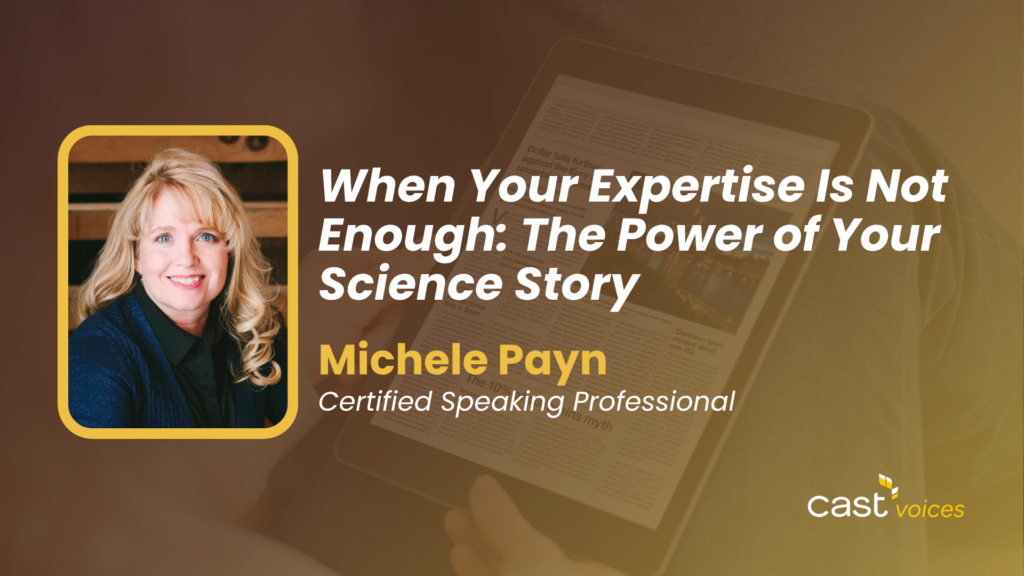

By Michele Payn
Certified Speaking Professional
Let’s start with an uncomfortable question for every agricultural scientist reading this. When did you last change someone’s mind?
Not convince a peer at a conference. Not publish findings that shaped policy years later. Actually changed a person’s belief or created a question mark in their mind – about what they eat, how food is grown, or whether science can be trusted.
If you’re struggling to answer, you are not alone. I’ve worked with scientists around the world who find it difficult to share the value of their work or converse about their passion for science with neighbors, friends, and consumers. And that gap is costing agriculture more than most scientists recognize.
The Credibility You’ve Earned Is Being Dismantled
A 2026 Harris Poll survey of more than 2,000 U.S. adults found that 86% of Americans believe false and misleading health and science information has gotten worse over the past five years. Three in four get their health and science information from social media at least monthly – more than from universities, peer-reviewed sources, or government agencies. And 75% of those who share health or science articles online admit to doing so based on the headline alone, without reading the full piece.
The Michigan State University 2022 Food Literacy and Engagement Poll narrowed the focus: fewer than half of Americans – 43% – trust academic scientists on food safety. Pew Research has tracked the same erosion across scientific topics broadly. And the Harris Poll found that roughly one in five adults ages 18–34 now distrust doctors and scientists as information sources – with more in that age group saying they would trust a friend with firsthand experience over a credentialed expert. That is the generation agriculture must win over for the next 40 years of farm policy, research funding, and consumer trust.
This is not a perception problem that better data will fix. It is a communication problem that only communicators who learn to really connect can solve.
Silence Is Not Neutral – It Is Concession
Scientists are trained to be precise, careful, and appropriately hedged. Those are virtues in a lab and liabilities in a public conversation. While a researcher qualifies findings with confidence intervals, a content creator with 500,000 followers publishes a thread claiming glyphosate causes cancer. One voice reaches a dozen people. The other reaches millions.
Science denialism was not born from ignorance. It was engineered. In December 1953, tobacco industry executives – facing research that linked cigarette smoking to lung cancer – hired public relations specialists to fight the science itself: full-page ads, alternative expert voices, and deliberate “both sides” framing designed to manufacture doubt (Michaels, D., 2008). By 1955, public polling showed little alarm. It took four more decades and the largest civil settlement in U.S. history to establish what industry insiders had known all along.
That blueprint – flood the zone, manufacture doubt, recruit dissenters – now runs at social media speed. It is active in conversations about GMOs, pesticide safety, animal agriculture, and food processing. The question is no longer whether scientists should engage the public. It is whether agriculture can afford the cost of their silence.
The Problem Is Translation, Not Knowledge
After more than 25 years working with agricultural scientists, farmers, dietitians, and communicators across six continents, I see a similar pattern when I speak. Brilliant researchers reduced to blank stares when asked to explain their work to a non-specialist. Farmers who know more about soil health than most people writing about it – unable to hold a room for three minutes.
The barrier is rarely knowledge. It is almost always translation – the difficulty of distilling complex topics into digestible pieces for the non-scientific community. You’ve spent years perfecting research and expertise on a subject, so how are you supposed to summarize it in two minutes? I felt so strongly about this translation that I co-authored a book and science communication training system to help.
One of the central arguments in Science Story Speak is that effective science communication requires understanding why before leading with what. Most scientists default to data – the what, the how, the measured result. But audiences process new information through the lens of existing beliefs, emotions, and identity.
Brain and behavioral science show that the prefrontal cortex – the seat of rational decision-making – is not where most people first receive a new idea. Story opens the door. Evidence walks through it, but only after you’ve connected on an emotional level.
This isn’t a call to oversimplify science. It is a call to understand your audience before you speak to them. Science Story Speak frames this through what my co-author Amy Hays calls “environmental ethos” – the way people perceive their own role in the environment and the food system. A rancher, a suburban parent, and a policy analyst may all care about water quality. They do not process information about it the same way, and they will not be moved by the same message.
Generational intelligence compounds this. A Baby Boomer scientist presenting soil carbon data to a Gen Z audience using mid-century communication habits is not just ineffective – it is counterproductive. Understanding the strengths, skepticisms, and information behaviors of each generation is now a baseline competency for anyone who needs to move science from the lab to the public square.
What is the Noise Costing Agricultural Science?
The translation gap plays out in familiar, costly ways for agricultural scientists. A wheat breeder publishes peer-reviewed research on wheat composition and gluten; a wellness author with no relevant credentials publishes a bestselling book claiming wheat has been “changed.” The book reshapes consumer behavior and processing. The research is cited by peers. Consumers start condemning gluten and stop buying bread.
The Science Story Speak workbook addresses this directly in its chapter on standing out in a noisy world: managing information has become a critical skill, and the ability to compete for space in the public conversation is no longer optional for scientists. That means knowing which platforms reach which audiences, what content performs, and how to translate technical knowledge into messaging that connects without distorting.
Declining trust in science does not stay in the abstract. It limits adoption of modern farming technologies. It expands regulatory pressure built on fear rather than evidence. It contributes to consumer questions that farmers field and feeds the mental health burden already weighing on farm families navigating a public that does not understand or trust their work.
Science Communication Is a Professional Responsibility
There is a version of this conversation that treats public engagement as optional – admirable for scientists who enjoy it, irrelevant for those who do not. That framing is no longer works.
Research budgets are defended before legislatures that answer to a public with eroding trust in science. Farmers adopt evidence-based practices in communities where that trust must be earned. Food safety guidance lands on an audience that may or may not be prepared to receive it. None of those outcomes is separable from how effectively scientists communicate.
The good news: these are learnable skills. Science Story Speak was built on the premise that science communication is not a gift some people have and others don’t – it is a system that can be taught. The workbook’s 17 chapters and more than 40 hands-on exercises walk scientists through audience analysis, knowledge brokering, message framing, platform selection, and action planning. The goal is not to turn researchers into influencers. It is to give them a repeatable framework for translating expertise into understanding – in the county extension office, the legislative hearing room, the classroom, and the comment section.
The Harris Poll also found that 75 percent of Americans are concerned about online content creators undermining scientific expertise. The public sees the problem. They are waiting for scientists to show up. Willl you?
A Challenge Worth Accepting
Agricultural scientists sit at the intersection of climate, nutrition, economics, ecology, and public health. The research you produce shapes what families eat, how land is managed, and whether the next generation inherits a food system it can trust. That is not a narrow mandate.
But it comes with a responsibility the scientific method alone cannot fulfill. You can produce the best research in the world. If no one outside your field can hear it, understand it, or act on it – it will not be enough.
Telling the story of science is no longer optional. There is an art to speaking science into a modern, skeptical community – and it can be learned. Will you?
Share this with a colleague, a graduate student, or a department chair who needs to hear it. Then take a next step:
→ Explore the Farm to Fork Communication resource library for tools built for agricultural scientists and communicators.
→ Learn about Science Story Speak training and the workbook – a practical system for turning scientific expertise into public trust.
References
The Harris Poll. (2026). Science Under Siege: The Battle Between Viral Misinformation and Shared Belief in the Value of Science. Commissioned by Bayer.
Michigan State University. (2022). Food Literacy and Engagement Poll. MSU AgBioResearch.
Michaels, D. (2008). Doubt Is Their Product: How Industry’s Assault on Science Threatens Your Health. Oxford University Press.
Payn, M. & Hays, A. (2024). Science Story Speak.
Pew Research Center. (2022). Public Trust in Scientists and Views on Their Role in Policy.
About the Author
Michele Payn, Certified Speaking Professional, connects the people and science of food and farming as principal of Cause Matters Corp. She is the award-winning author of four books, including Science Story Speak, Food Bullying, Food Truths from Farm to Table, and No More Food Fights. Payn has worked with scientists, farmers, and communicators in more than 25 countries and is passionate about global food security. A Michigan State University graduate in Agricultural Communications and Animal Science, she has spent 25 years as a professional speaker helping agriculture have tougher, smarter conversations with a skeptical public. Follow @mpaynspeaker on social channels or visit causematters.com for a variety of resources to empower voices from farm to food.
About Voices of Agriculture
The Voices of Agriculture series is designed to provide a platform for diverse perspectives on issues, trends, and experiences within the agricultural community. These articles aim to foster dialogue, share insights, and highlight the many voices that contribute to the ongoing conversation about agriculture and its future.
Disclaimer
The opinions expressed in this article are solely those of the author. They do not necessarily represent the views, positions, or policies of the Council for Agricultural Science and Technology (CAST). CAST provides this space to encourage thoughtful discussion, but does not endorse any specific viewpoints shared in these pieces.