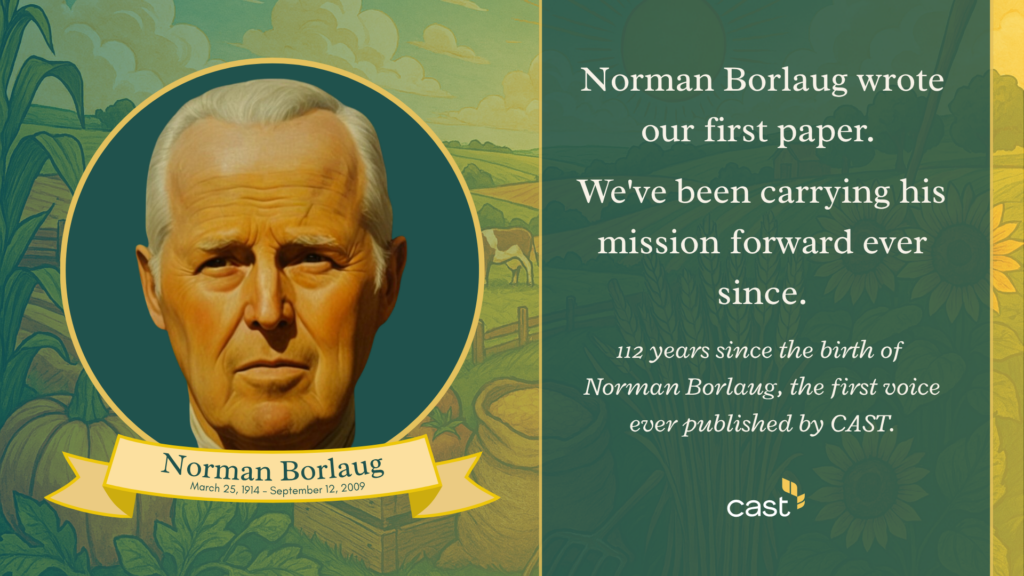

Norman Ernest Borlaug was born on March 25, 1914, in Saude, Iowa. After completing his primary and secondary education in Cresco, he enrolled at the University of Minnesota, where he studied forestry, then returned to study plant pathology, earning his master’s degree in 1939 and his doctorate in 1942. In 1944, he accepted an appointment as geneticist and plant pathologist to direct the Cooperative Wheat Research and Production Program in Mexico, a joint undertaking by the Mexican government and the Rockefeller Foundation.
The Green Revolution resulted in increased production of food grains — especially wheat and rice — and was in large part due to the introduction into developing countries of new, high-yielding varieties, beginning in the mid-20th century with Borlaug’s work. In 1970, Borlaug was awarded the Nobel Peace Prize. He was the first agricultural scientist to receive the Nobel Peace Prize. He also received the Presidential Medal of Freedom (1977), the National Medal of Science (2004), and the Congressional Gold Medal (2006), making him one of only seven individuals in history to have earned all three of the United States’ highest civilian honors.
Borlaug and CAST: A relationship that began at the beginning.
Borlaug had a long history of involvement with the Council for Agricultural Science and Technology. His remarks as the invited speaker at the organization’s conference in 1973 became its first published paper. That paper — Agricultural Science and the Public — established the tone CAST has carried for more than five decades.
In 1982, the Council for Agricultural Science and Technology presented Borlaug its initial Distinguished Achievement Award in Food and Agricultural Science. In 2005, Borlaug received the organization’s Charles A. Black Award for his contributions to public policy and the public understanding of science.
The Borlaug CAST Communication Award was introduced in 2010, replacing the Charles A. Black Award, which was given from 1986 through 2009. The award is dedicated to Dr. Norman E. Borlaug, “The Man Who Fed the World” and author of the first CAST publication in 1973. It recognizes outstanding achievement in communicating agricultural science to the public, policymakers, and the news media.
On March 25, 2014, a statue of Borlaug at the United States Capitol was unveiled in a ceremony on the 100th anniversary of his birth, replacing the statue of James Harlan as one of Iowa’s two statues in the National Statuary Hall Collection.
Borlaug died on September 12, 2009, at the age of 95, in Dallas, Texas. His scientific and personal papers are held at Iowa State University’s archives of American agriculture. CAST Paper No. 1 remains freely available.