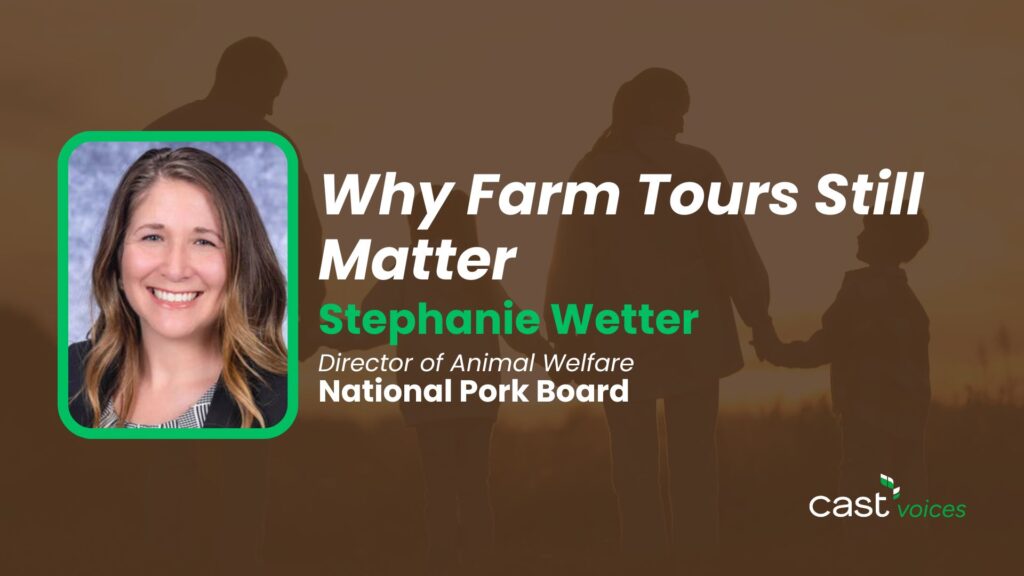

By Stephanie Wetter
Director of Animal Welfare, National Pork Board
I did not grow up in agriculture.
Everything I know about pork production, I had to learn as an adult. I found pigs in college through animal science, and what started as curiosity became a career. I was drawn not only to the animals, but to the people raising them and the complexity of the systems they manage every day. That background still shapes how I approach my work, because I remember what it feels like to stand outside agriculture looking in.
That is one reason I care so much about taking people to pig farms.
In my role, I spend a lot of time talking about animal welfare, sustainability, and responsible pork production with people across the supply chain. Those conversations are important, but there is a limit to what can be understood from a meeting room alone. Farm tours matter because they give people the chance to see, firsthand, how pigs are raised and how much thought, care, and daily management go into doing that work and doing it right.
They also make our industry’s programs real.
It is one thing to explain that pork producers uphold our We Care® ethical principles and participate in programs like Pork Quality Assurance® Plus, Transport Quality Assurance®. It is another thing entirely to see those commitments in action. On a farm tour, people can connect the words to the work. They can see animal caretakers paying attention to pig behavior and comfort. They can see facilities, handling, biosecurity, transportation planning, feed systems, manure management, and environmental stewardship as part of one connected system. They can see that these are not just programs on paper. They are part of how producers operate every day.
That matters.
Too often, conversations about agriculture happen at a distance. Policies are discussed in boardrooms. Expectations are developed in offices. Questions are raised by people who may never have stepped inside a commercial barn or talked at length with the people doing the work. When that happens, it becomes easy to miss the reality that pig farming is full of tradeoffs, practical constraints, and daily decisions that affect animals, people, and the environment simultaneously.
Farm tours help close that gap.
They show that animal welfare is not a slogan. It is daily attention to health, behavior, facility design, stockmanship, and care. They allow people to see that environmental stewardship is not separate from production. It is built into how feed is sourced, how manure nutrients are managed, and how farms think about long-term land use and resources. They also allow people to see how much producers care not only for their animals but for the people who work on their farms and for the communities around them.
For me, these tours are not just educational events. They are part of the work of building understanding and trust.
I have found that when people see a real pig farm, their questions get better. The conversation becomes more grounded. Assumptions start to fall away. People begin to understand that responsible production is not about finding one perfect answer. It is about making good decisions, using science, training people well, caring for animals, and continually improving over time.
That is especially important in pork production, where public expectations around animal welfare, sustainability, and social responsibility are not going away. Agriculture cannot meet those expectations by staying silent or assuming people will understand what happens on the farm without ever seeing it. We must be willing to open the door, explain what we do, and have honest conversations about both the progress we have made and the trade-offs that still exist.
That work matters to me personally because I have lived both sides of it. I have been the person asking questions from outside agriculture, and I have become the person helping others understand it from the inside. That perspective makes me believe even more strongly that one of the best ways to communicate the value of modern agriculture is to let people experience it.
Sometimes the most important thing we can do is get people out of the boardroom, onto a bus, and onto a farm.
That is where understanding starts.
___
About Voices of Agriculture
The Voices of Agriculture series is designed to provide a platform for diverse perspectives on issues, trends, and experiences within the agricultural community. These articles aim to foster dialogue, share insights, and highlight the many voices that contribute to the ongoing conversation about agriculture and its future.
Disclaimer
The opinions expressed in this article are solely those of the author. They do not necessarily represent the views, positions, or policies of the Council for Agricultural Science and Technology (CAST). CAST provides this space to encourage thoughtful discussion, but does not endorse any specific viewpoints shared in these pieces.