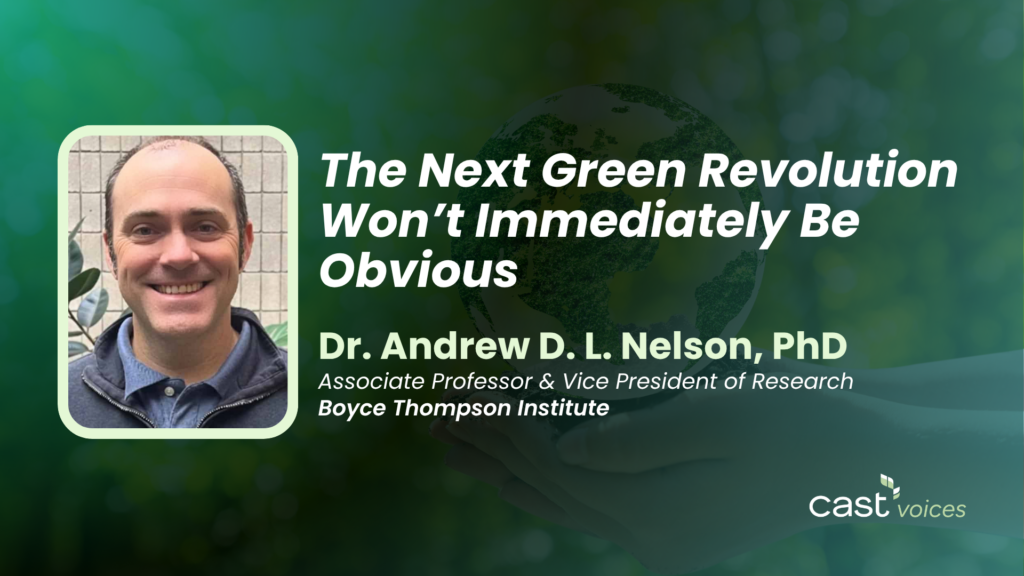

By Dr. Andrew D. L. Nelson, PhD
Associate Professor and Vice President of Research, Boyce Thompson Institute
When people think about agricultural innovation, they picture autonomous tractors, laser-wielding robots, gene editing, or the latest biological crop protection products. These technologies are transforming farming, but they are only the final chapter of a much longer story.
Fundamental plant discoveries, made through field observations, laboratory experiments, or serendipitous “eureka” moments at the coffee pot, often aren’t obvious at first. Nearly every breakthrough in agriculture, from disease-resistant crops and improved nutrition to biological crop protection and genomic breeding tools, began decades before farmers benefited from it. Long before technology reaches the marketplace, it begins as curiosity-driven science: researchers seeking to understand how plants, microbes, or insects work, often uncovering impacts beyond their original questions. Fundamental discoveries often matter first to only a handful of scientists before the dots are connected and they become sector-changing innovations.
Agriculture faces extraordinary challenges and needs more innovations like these. Growers around the world are coping with weather extremes, such as intensifying droughts, floods, and heat stress. New pests and diseases are expanding into regions where they have never existed before. Rising input costs and changing societal expectations mean growers must produce more food with fewer resources and a smaller environmental footprint. Meeting these challenges will require innovations we have not yet imagined. Developing them will require investment in fundamental plant science and connecting discoveries to applications.
That philosophy has guided the Boyce Thompson Institute for more than a century. In 1917, William Boyce Thompson traveled to revolutionary Russia with the American Red Cross and witnessed firsthand how food insecurity could destabilize entire societies. He returned to Yonkers convinced that lasting solutions would come not from reacting to crises, but from understanding plants deeply enough to prevent them. When he founded BTI in 1924, he embraced the idea: investing in fundamental plant science would generate discoveries whose greatest impact might not be immediately apparent.
History has repeatedly proven him right. One of the best examples began in the late 1980s, when BTI scientist Robert Granados was studying an insect pest that threatened cabbage crops. His goal was to understand the cabbage looper, not advance human medicine. During that research, his laboratory isolated what became the HighFive ™ insect cell line. Today, HighFive cells are widely used to produce recombinant proteins and were instrumental in manufacturing Cervarix, one of the first vaccines developed to protect against human papillomavirus (HPV). Research that began with protecting plants from insects ultimately helped protect people from cancer.
The HighFive cell line isn’t an isolated case. BTI researchers Dan Klessig and Frank Schroeder, after talking through an observation over a cup of coffee, ended up working together to make an unexpected discovery. They found that tiny molecules known as ascarosides, that come from soil-dwelling worms, can activate powerful immune responses in plants. That fundamental discovery eventually led to the development of Phytalix ®, a biological crop protection technology based on naturally occurring soil molecules. Four years of field trials have demonstrated that Phytalix can match, and in some cases outperform, traditional fungicides against devastating diseases such as northern corn leaf blight, Asian soybean rust, and Fusarium head blight in wheat. Those discoveries became the foundation for Ascribe Bioscience, demonstrating how basic research can ultimately deliver farmers new tools.
Sometimes the impact of discovery is not a product, but a platform that empowers others to innovate. As plant breeding has entered the genomic era, researchers have unlocked unprecedented amounts of genetic information. Yet for many breeding programs, particularly in developing countries, managing these data has become a significant obstacle. To address this challenge, BTI scientist Lukas Mueller led a collaboration to develop Breedbase, an open-source breeding platform that standardizes data management and provides advanced analytical tools for breeders worldwide. Today, Breedbase supports breeding efforts across over 50 crops, accelerating development of more productive, resilient, and nutritious varieties.
These breakthroughs may appear unrelated. An insect cell line, a biological crop protection technology, and an international breeding database. But, they share the same origin. Each began with scientists trying to address fundamental biological processes. None started with a product roadmap or business plan. They remind us that curiosity-driven research is not separate from agricultural innovation but simply requires connecting discovery to application.
One of the greatest challenges facing agricultural research today is ensuring that promising discoveries do not remain confined to scientific journals. Translating breakthrough science into practical solutions requires proof-of-concept studies, intellectual property development, industry partnerships, and investment during the critical period between discovery and commercialization. Too often, this “missing middle” determines whether a discovery changes the world or remains an interesting publication.
Recognizing this challenge, BTI established its Center for Translational Research to help bridge the gap between laboratory discovery and real-world impact. Working alongside researchers, entrepreneurs, and industry partners, the Center moves promising technologies toward commercial readiness to benefit farmers, consumers, and society. As we look toward the future, the agricultural community has an extraordinary opportunity. The next breakthrough in climate resilience, sustainable crop protection, or plant nutrition may already exist in a laboratory somewhere. Our responsibility is not only to support the curiosity that leads to those discoveries, but to build the connections that allow them to reach those who need them most.
The next Green Revolution won’t begin with a product launch or a new machine in the field. It will begin much earlier, with a scientist asking a question, a researcher following an unexpected result, and a society willing to invest in discovery long before the answers are known. At BTI, we have spent our first century asking those questions, following unexpected results, and translating discoveries to the field. This model, replicated across labs and fields worldwide, is how agriculture advanced over the past century and will meet the challenges of the next.
About Voices of Agriculture
The Voices of Agriculture series is designed to provide a platform for diverse perspectives on issues, trends, and experiences within the agricultural community. These articles aim to foster dialogue, share insights, and highlight the many voices that contribute to the ongoing conversation about agriculture and its future.
Disclaimer
The opinions expressed in this article are solely those of the author. They do not necessarily represent the views, positions, or policies of the Council for Agricultural Science and Technology (CAST). CAST provides this space to encourage thoughtful discussion, but does not endorse any specific viewpoints shared in these pieces.