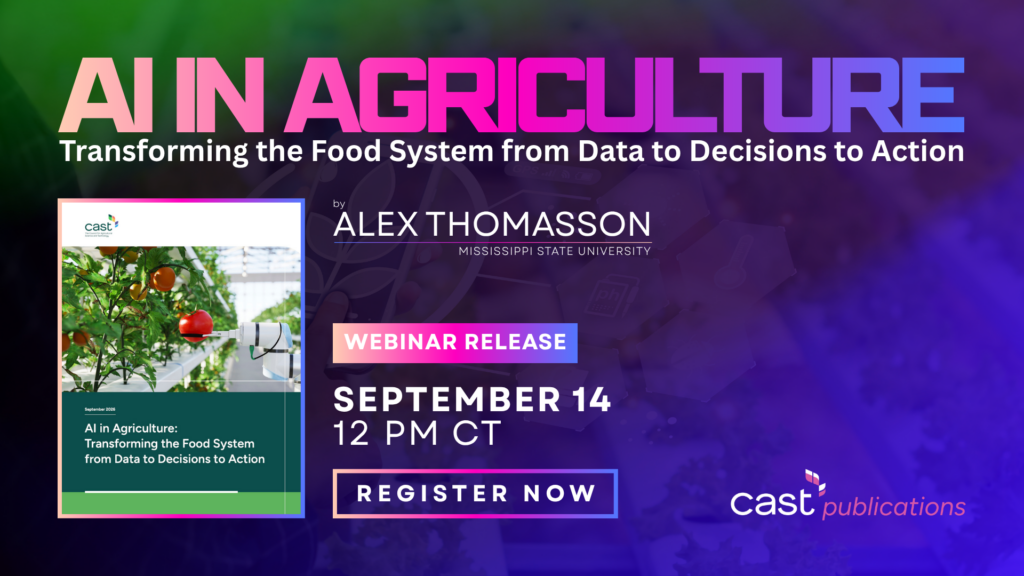

AMES, Iowa — September 8, 2026 — The Council for Agricultural Science and Technology (CAST) today released AI in Agriculture: Transforming the Food System from Data to Decisions to Action, a new peer-reviewed policy brief examining how artificial intelligence is already reshaping American food and agriculture, helping researchers, farmers, and food companies improve efficiency, strengthen resilience, conserve resources, and deliver a safer food supply. Yet federal policy is not keeping pace.
The brief was authored by Alex Thomasson, Professor & Director of the Agricultural Autonomy Institute at Mississippi State University, and synthesizes current peer-reviewed research to assess where AI adoption stands today, where it is headed, and what gaps in federal policy, infrastructure, and workforce development must be addressed to realize its full potential.
“Artificial intelligence has advanced so fast that it’s not really just a research tool anymore; it’s embedded in agricultural practice now,” said Thomasson. “From autonomous weed spraying to AI-assisted seed selection to real-time food safety inspection on processing lines, the technology is already changing how farmers work, how food moves through the system, and what we expect from that system. The policy conversation needs to catch up.”
The brief identifies five key findings. First, AI is no longer a future promise: it is in active use across crop production, animal agriculture, and food supply chains, creating benefits for farmers and consumers, but also creating new policy questions. Second, AI is evolving from a data analysis tool to a system that takes physical action — what the brief terms “physical AI” — with autonomous machinery and robotics increasingly moving from demonstration to commercial deployment. Third, data quantity and quality are foundational to AI performance, making rural data infrastructure a critical policy priority. Fourth, AI is being applied across every segment of the food system, from genetic seed selection to optical food safety inspection. Fifth, federal policy decisions on data centers, rural broadband, data ownership, and workforce development play a role in how AI benefits American agriculture and whether rural communities capture the economic gains of AI locally.
“How AI develops, how it is used in agriculture, and who has access to it over time are going to be heavily influenced by policy decisions, many of which are made by legislators,” Thomasson said. “We need funds for research, we need broadband connectivity in rural areas, we need clarity around data ownership, and we need to invest in the workforce that can build and maintain these systems. None of that happens without policy.”
Chris Boomsma, Executive Director of CAST, said the brief reflects the organization’s core mission of making agricultural science accessible to policymakers.
“CAST exists to translate agricultural science into policy-relevant guidance, and AI in agriculture is exactly the kind of complex, fast-moving topic where evidence-based analysis matters most,” said Boomsma. “This brief gives Congress and federal agencies the scientific foundation they need to make smart decisions right now, not after the technology has outpaced the regulatory environment entirely.”
The brief is available for download at https://cast-science.org/publication/ai-in-agriculture-transforming-the-food-system-from-data-to-decisions-to-action/
CAST will host a free public webinar on September 14, 2026 at noon CT, during which Thomasson will present the brief’s key findings and take questions. Registration is available at https://streamyard.com/watch/wn5bvM9tgG4K