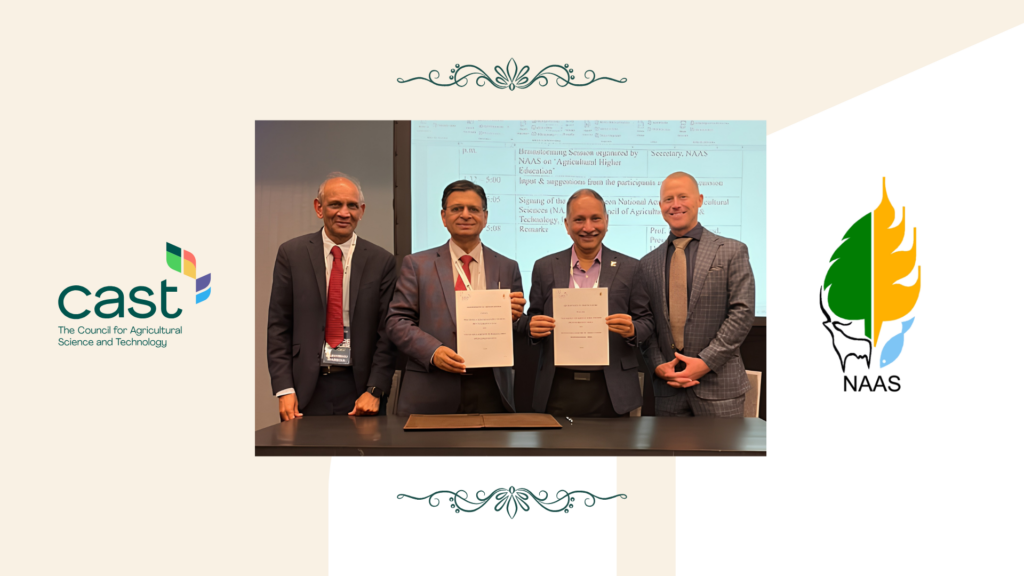

AMES, Iowa (Oct. 22, 2026) — The Council for Agricultural Science and Technology (CAST) and India’s National Academy of Agricultural Sciences (NAAS) signed a cooperation agreement on Oct. 20 to strengthen scientific collaboration and help policymakers and the public understand issues affecting food, farming and natural resources. The memorandum of understanding, signed during the 2026 Norman E. Borlaug International Dialogue in Des Moines, establishes an initial five-year framework for educational programs, publications and scientific exchanges between the United States and India.
“CAST and NAAS share a commitment to ensuring that agricultural science serves society,” said P.V. Vara Prasad, president of CAST; university distinguished professor and R.O. Kruse Endowed Professor at Kansas State University; and director of the Sustainable Intensification of Targeted Agricultural Systems Innovation Lab and the Center for Crops, Climate and Communities. “This partnership brings together complementary strengths to exchange knowledge, inform decisions and develop future leaders. Our goal is to build a lasting collaboration that strengthens both organizations and benefits the United States, India and the broader global community.”
Topics of shared interest include food and nutrition security, water availability and quality, adapting agriculture to environmental stresses, artificial intelligence and digital farming tools, biotechnology and gene editing, renewable energy, and protecting natural resources.
“NAAS is a policy think tank that brings together partners from across India and around the world to discuss key issues in agricultural research and development,” said M.L. Jat, president of NAAS, secretary of India’s Department of Agricultural Research and Education (DARE) and director general of the Indian Council of Agricultural Research (ICAR). “We are moving from production-centric agriculture toward a broader focus on the agrifood value chain. I am confident that our partnership with CAST will open new avenues for collaboration in agricultural research, capacity development and knowledge exchange. I look forward to everyone’s contributions to our shared mission of transforming agrifood systems worldwide through research, education and extension.”
Making agricultural science easier to understand and use
CAST and NAAS will explore webinars, workshops and discussions that connect scientists with policymakers, educators, businesses and the public. Activities may be developed jointly or build on existing programs offered by either organization.
“Scientific information is most useful when people can understand it and see why it matters,” said Chris Boomsma, chief executive officer of CAST. “Together, CAST and NAAS can explain complex agricultural issues in clear, practical terms and help policymakers and the public make informed decisions about food, farming and natural resources.”
The organizations will also share experience in recognizing scientific achievement, organizing expert advice and informing policy. These exchanges will support CAST’s ongoing efforts to strengthen its role as a trusted scientific convener and resource for the United States, while offering NAAS opportunities to engage with CAST’s multidisciplinary expert networks, publications, and educational programs.
“This partnership creates valuable opportunities to exchange ideas, connect experts and learn from one of the world’s leading agricultural academies,” Boomsma said. “We look forward to building scientific collaboration between two of the world’s largest democracies to address the challenges facing agriculture.”
Putting the agreement into practice
Proposed initial activities include a jointly hosted webinar, a jointly produced science communication or policy product, and a leadership exchange focused on strengthening scientific organizations and their contributions to policy. The organizations will also explore a CAST–NAAS Distinguished Agricultural Science Lecture series and a recurring joint presence at the World Food Prize Borlaug Dialogue and other meetings of mutual interest.
“Our priority is to turn this agreement into practical activities that draw on the expertise of both organizations,” said B.S. Dwivedi, secretary of NAAS. “We will identify shared priorities, encourage participation in each other’s programs and develop opportunities for collaboration. Clear planning and regular review will help us sustain progress on issues that matter to agriculture and society.”
The partnership will also explore mentoring, educational programs and scientific exchanges for students and early-career scientists, with an emphasis on leadership, science communication and participation in public discussions about agriculture.
“Lasting international cooperation begins with relationships between people,” said Karim Maredia, foreign secretary of NAAS and professor, associate dean and director of the World Agriculture Center at Michigan State University. “Connecting emerging scientists with experienced leaders helps them develop skills, share ideas and build collaborations across countries. These relationships can strengthen agricultural science well beyond any single project.”
About CAST
The Council for Agricultural Science and Technology (CAST) is an independent nonprofit organization founded in 1972 and based in Ames, Iowa. CAST brings together experts from different fields to provide credible, balanced, science-based information about food, agriculture, natural resources and the environment. Through peer-reviewed publications, educational programs and public discussions, CAST helps policymakers, the media, businesses and the public understand research and use it in decision-making.
About NAAS
The National Academy of Agricultural Sciences (NAAS), India, was established in 1990 and is based in New Delhi. The Academy promotes excellence in agricultural science, recognizes distinguished scientists and provides scientific input to help inform agricultural policy. Through publications, scientific meetings and collaboration among experts in India and abroad, NAAS advances agricultural research, education and the exchange of knowledge to support productive and environmentally sustainable agriculture.