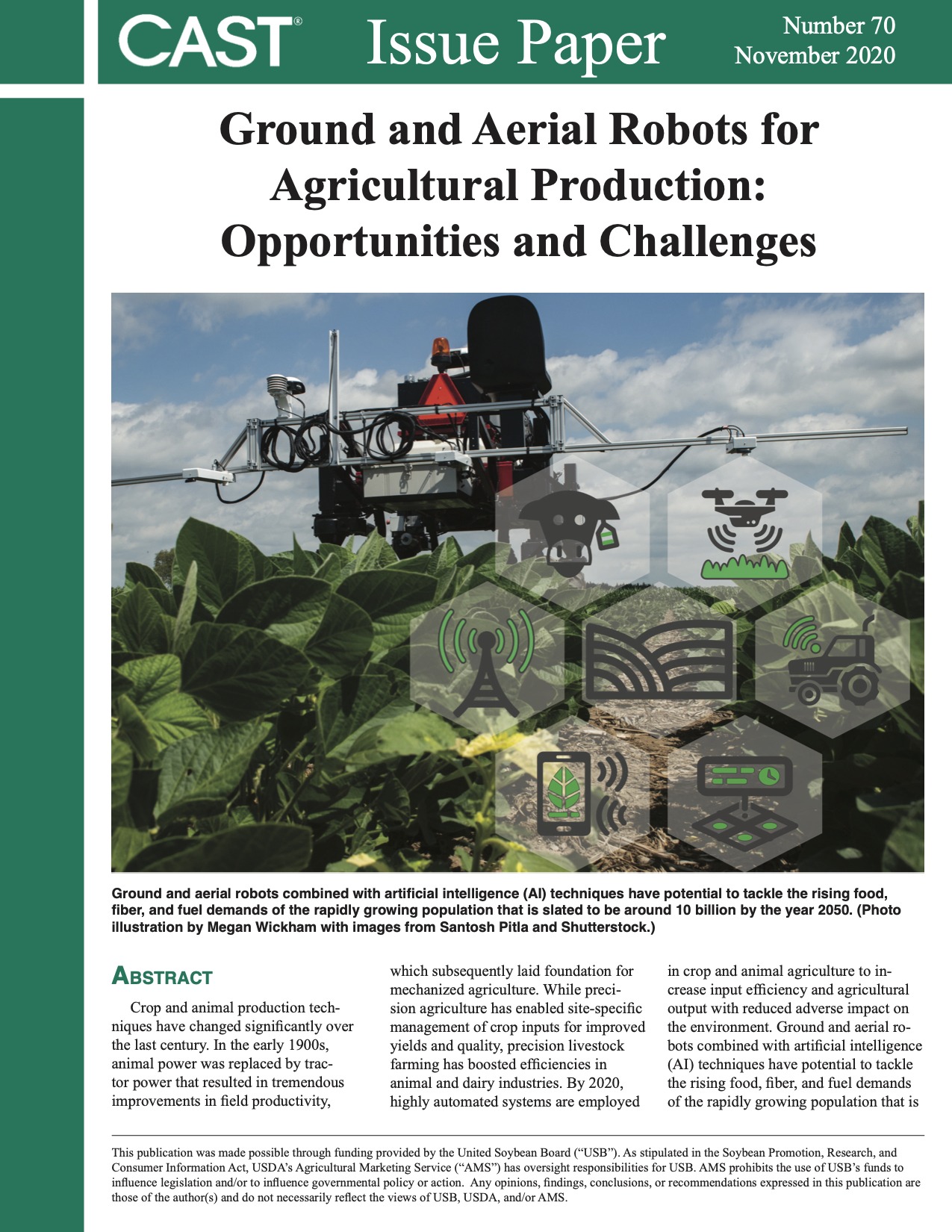
Rapid advances in automation, robotics, and artificial intelligence are reshaping agricultural production. This paper examines the emerging roles of ground and aerial robotic systems—unmanned ground vehicles (UGVs), unmanned aerial systems (UASs), and robotic manipulators—in crop and livestock systems. Robots now offer novel opportunities to improve labor efficiency, enhance precision in input management, reduce environmental impacts, and increase productivity across row crops, specialty crops, and animal agriculture. UGVs enable continuous, highly precise field operations while reducing soil compaction and offering scalable, swarm-based solutions. UASs provide high‑resolution sensing capabilities for crop monitoring, disease detection, and targeted input application. Robotic manipulators are advancing tasks such as automated milking, fruit harvesting, weeding, and livestock monitoring. Despite their potential, widespread adoption is challenged by technical barriers (e.g., autonomy, machine vision, sensor integration), economic feasibility, limited rural broadband connectivity, and evolving regulatory, liability, and data privacy concerns. The paper highlights key enabling technologies—including AI, machine vision, big data infrastructure, and interoperability standards—and emphasizes the need for workforce training that integrates agricultural, engineering, and data science skills. Ultimately, the deployment of agricultural robots promises to transform farming into a more efficient, data-driven, and sustainable system, provided that economic, technical, and policy challenges are addressed.