CAST papers are developed by interdisciplinary task forces composed of volunteer authors, chairs, reviewers, liaisons, and translators from academia, industry, and government. This index recognizes those contributors and highlights the breadth of expertise that supports CAST’s work.

A. David Scarfe

Affiliation
American Veterinary Medical Association
Publications as CAST Liaison
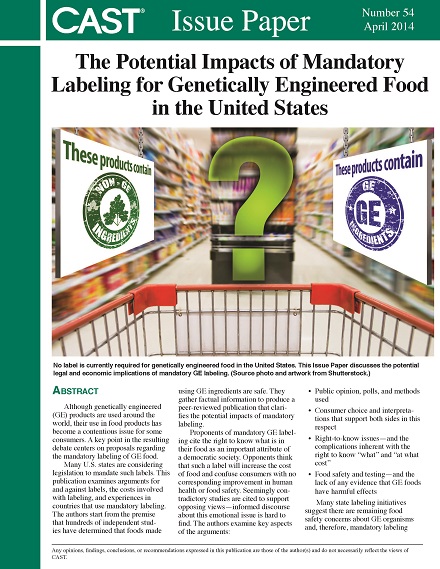
CAST-IP54_GE-Labeling.jpg
Although genetically engineered (GE) products are used around the world, the issue becomes contentious when they are present in our food. A key part of the resulting debate centers on proposals regarding the mandatory labeling of GE food. With some states considering legislation to mandate such labels, this CAST Issue Paper (IP 54) examines arguments for and against labels, the costs involved with labeling, and experiences in countries that use mandatory labeling.
CAST-IP53_Feed-vs-Food.jpg
A popular belief exists that animal agriculture competes for human food supplies and wastes resources. Little scientific information exists regarding this concept, and it is therefore necessary to quantify human-inedible feedstuff use and re-examine the feed efficiency concept using a ratio of human-edible feedstuff input to human-edible (animal protein) output. This paper (IP 53) addresses the commonly heard argument that livestock compete with humans for food resources, thus providing support for the continued existence of livestock production. It also addresses the knowledge gap that currently exists as to the quantity of human feed and fiber by-products used within animal agriculture.
CAST-IP50_Water-Land-Issues.png
This paper (IP 50) addresses specific water and land concerns related to animal agriculture. The authors consider issues of water use and water quality associated with the livestock sector and the related environmental and economic impacts. The paper also includes a discussion of livestock land use, land degradation, land application of manure and manure-based composts, and deforestation related to farm policies. This Issue Paper presents scientific data specific to North America (primarily the United States) and explains how and why these data compare with other parts of the world. Additionally, it discusses how to reduce the environmental impact of livestock agriculture while preserving resources and quality of life.
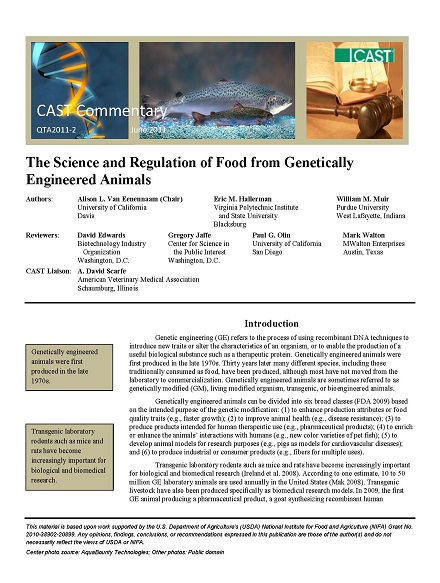
QTA2011-2-GE-Food.jpg
Humans and animals have been consuming genetically engineered (GE) food from plants for decades, but the recent approval of GE salmon intended as human food has resulted in debate and some controversy. Many still have concerns about the environmental impact and food safety issues of such an approval. More research is needed as policymakers struggle with laws ranging from the approval of GE procedures to the labeling of such food in the markets. This Commentary looks at how GE animals are currently regulated and what type of data is needed to demonstrate the safety of GE organisms. The authors also look at the opportunities for public participation in the regulatory process and the implications for the future of this technology.
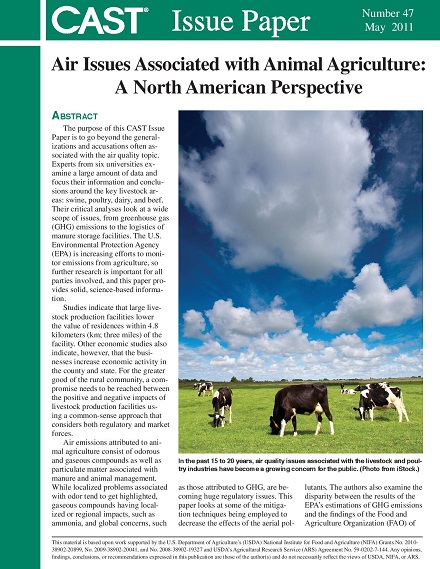
CAST-IP47_Air-Issues.jpg
The purpose of this CAST Issue Paper (IP 47) is to go beyond the generalizations and accusations often associated with the air quality topic. Experts from six universities examine a large amount of data and focus their information and conclusions around the key livestock areas: swine, poultry, dairy, and beef. Their critical analyses look at a wide scope of issues, from greenhouse gas emissions to the logistics of manure storage facilities. The U.S. Environmental Protection Agency is increasing efforts to monitor emissions from agriculture, so further research is important for all parties involved, and this paper provides solid, science-based information.
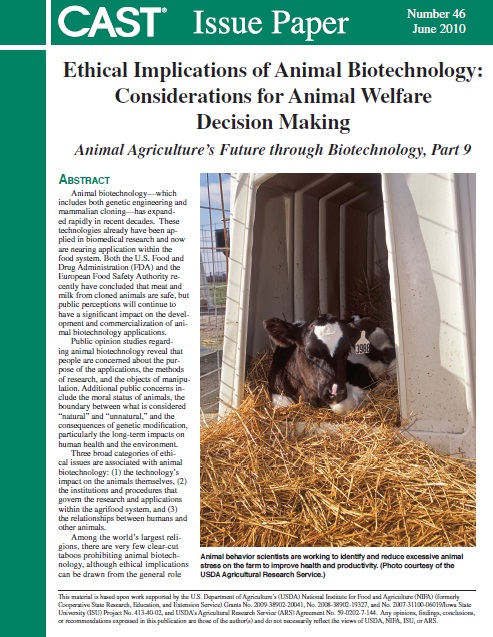
CAST-IP46_Ethical-Perspectives.jpg
Animal biotechnology, which includes both genetic engineering and mammalian cloning, has expanded rapidly in recent decades. These technologies already have been applied in biomedical research and now are nearing application within the food system. This paper from CAST (IP 46) reviews animal biotechnology techniques, discusses related key ethical issues, evaluates religious views and traditions regarding animal biotechnology, summarizes public opinion research on the topic, and evaluates the challenges and opportunities for the ethical development of agricultural animal biotechnology.
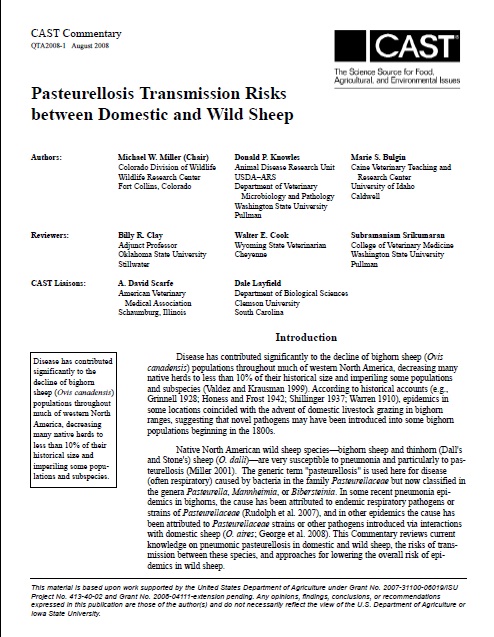
QTA2008-1-Sheep-Pasteurellosis.jpg
Native North American wild sheep species are very susceptible to pneumonia and particularly to pasteurellosis. Although the current understanding about pasteurellosis in wild and domestic sheep is incomplete, respiratory disease clearly is a serious problem in both. This Commentary discusses pneumonic pasteurellosis in domestic sheep, pasteurellosis in wild sheep, and the risks to wild sheep associated with domestic sheep interactions. The authors also address research needs and strategies for minimizing the risk of interspecies disease transmission.