CAST papers are developed by interdisciplinary task forces composed of volunteer authors, chairs, reviewers, liaisons, and translators from academia, industry, and government. This index recognizes those contributors and highlights the breadth of expertise that supports CAST’s work.

Drew Kershen

Publications as Task Force Chair
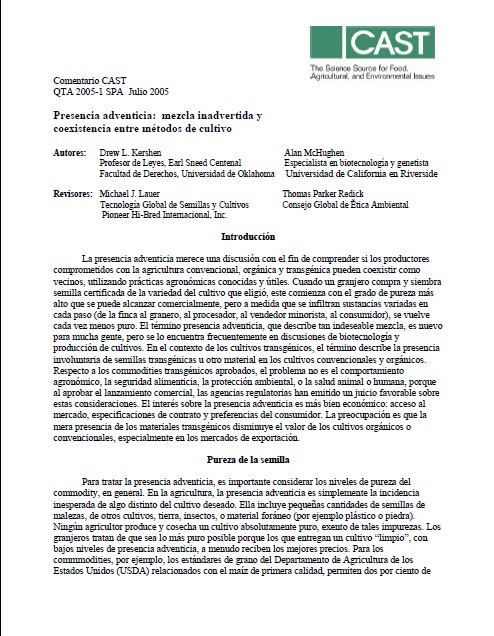
QTA2005-1 Adventitious (SPA)
La presencia adventicia se refiere a la mezcla no intencional de cantidades mínimas de un tipo de semilla o producto, con otro. Aunque este proceso puede ocurrir con los cultivos obtenidos en forma tradicional, la presencia adventicia normalmente contempla las semillas y productos de ingeniería genética en un material que no la ha experimentado. Este documento provee un marco de trabajo para discutir el desarrollo de una política basada en la ciencia para aplicar a la presencia adventicia.
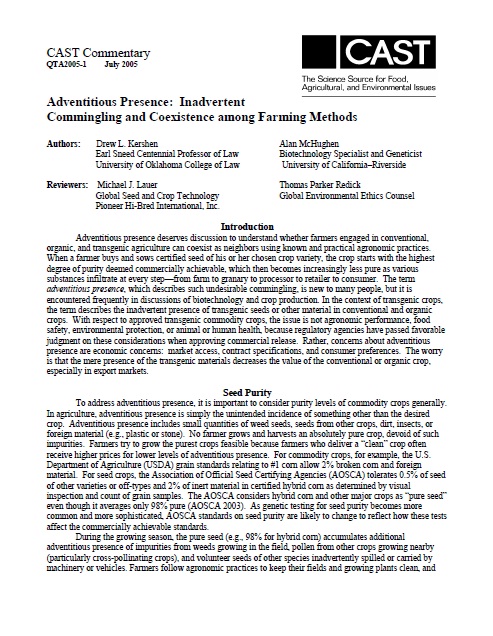
QTA2005-1-Adventitious.jpg
Adventitious presence refers to the unintended commingling of trace amounts of one type of seed, or product, with another. Although this process can occur with conventionally bred crops, adventitious presence is more commonly regarded as the presence of genetically engineered (GE) seed and product in non-GE material. This document will provide a framework to discuss development of a science-based policy for adventitious presence.
Publications as Reviewer
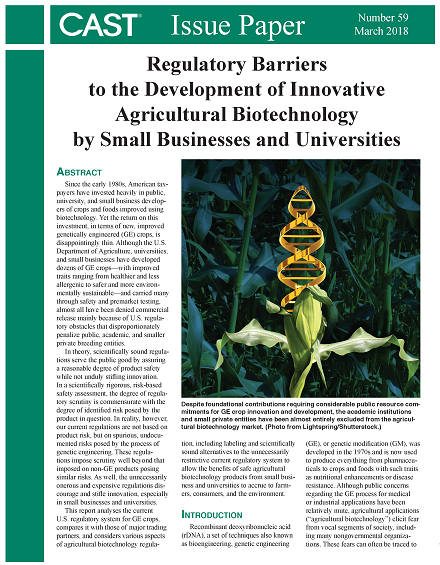
CAST-IP59_Biotech-Regs.png
This report examines the current U.S. regulatory system for GE crops, compares it with those of major trading partners, and considers the effects it has on agricultural biotechnology. The authors of this CAST Issue Paper show that despite foundational contributions requiring considerable public resource commitments for GE crop innovation and development, academic institutions and small private entities have been almost entirely excluded from the agricultural biotechnology market. The regulatory system needs to be adjusted, or "public, academic, and small business entities will continue to be frustrated in using these safe tools to deliver useful products."
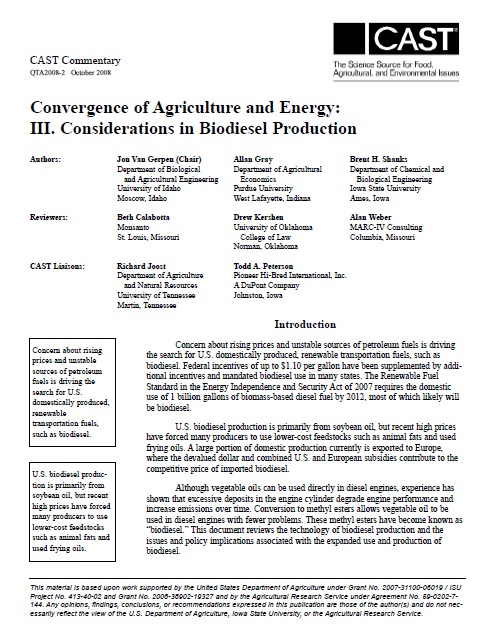
QTA2008-2 Convergence 3
Concern about rising prices and unstable sources of petroleum fuels is driving the search for U.S. domestically produced, renewable transportation fuels, such as biodiesel, which is developing into a widely accepted alternative fuel. The U.S. biodiesel industry is struggling because of high prices for its feedstocks, vegetable oils, and animal fats. High feedstock prices also are affecting international biodiesel production, but requirements to lower greenhouse gas emissions continue to stimulate interest in the fuel. The authors of this new CAST Commentary explain the biodiesel production process and discuss quality requirements, characteristics of biodiesel, biodiesel economics, and energy balance.