CAST papers are developed by interdisciplinary task forces composed of volunteer authors, chairs, reviewers, liaisons, and translators from academia, industry, and government. This index recognizes those contributors and highlights the breadth of expertise that supports CAST’s work.

Thomas Redick

Publications as Task Force Chair
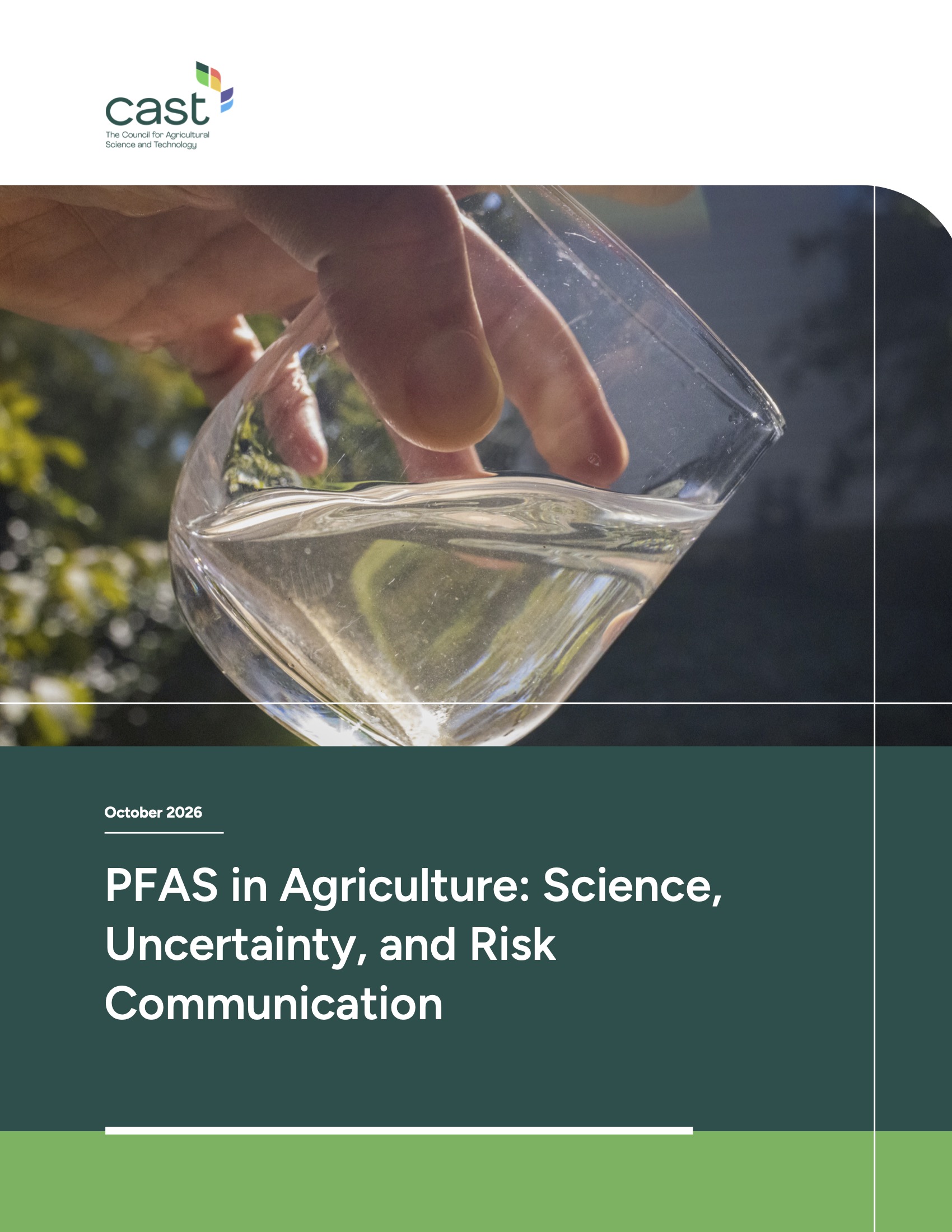
CAST_PFAS in Agriculture- Science Uncertainty and Risk Communication_EM
PFAS, often called “forever chemicals,” are a growing regulatory and economic challenge for agriculture, even though farms usually sit downstream from contamination sources such as biosolids, compost, irrigation water and industrial sites. This paper argues that treating thousands of chemically diverse compounds as one uniform hazard distorts policy and penalizes farmers. Detection is not the same as risk: the strongest health evidence centers on a few compounds, mainly PFOA and PFOS. The authors review federal and state regulation, litigation and EPA’s 2026 draft biosolids guidance, and recommend source control, strategic testing, compound-by-compound interpretation, documentation and early, credible risk communication.
Publications as Reviewer
CAST-IP56-SPA_Process-Labeling.png
Los consumidores de hoy no pueden observar directamente los procesos de producción de los alimentos que consumen, por lo que se guían frecuentemente por etiquetas que comunican aspectos específicos del proceso productivo. Este artículo de CAST examina lo que se conoce sobre las reacciones de los consumidores ante las etiquetas de proceso, presenta un marco legal para el etiquetado alimentario y ofrece directrices de política que identifican cuándo el etiquetado de proceso beneficia o perjudica al sector agrícola y a los consumidores.
CAST-IP56_Process-Labeling.jpg
We live in a world of labels, and even though information is crucial, some labeling leads to confusion, negative views, and misunderstanding. In the supermarket, consumers might misinterpret "facts" or develop disparaging images. The authors of this paper look at the impact labeling has on the food industry—the choices consumers make, the way labeling affects the adoption of technology, and the influence labeling might have on the amount of money spent for research and product development. Legislators, regulatory officials, and consumers will benefit from the thoughtful, science-based information in this Issue Paper.
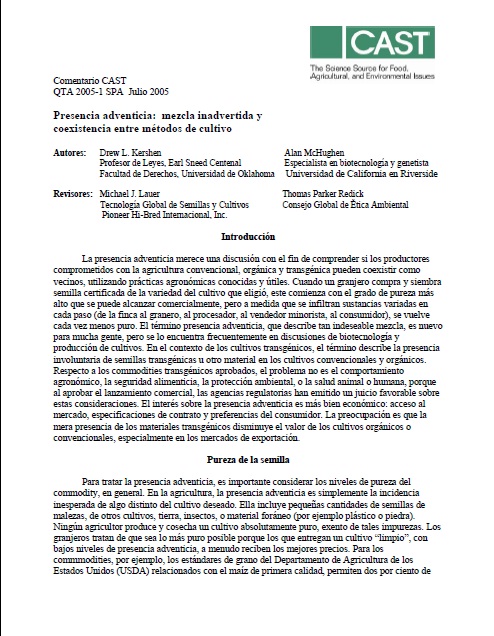
QTA2005-1 Adventitious (SPA)
La presencia adventicia se refiere a la mezcla no intencional de cantidades mínimas de un tipo de semilla o producto, con otro. Aunque este proceso puede ocurrir con los cultivos obtenidos en forma tradicional, la presencia adventicia normalmente contempla las semillas y productos de ingeniería genética en un material que no la ha experimentado. Este documento provee un marco de trabajo para discutir el desarrollo de una política basada en la ciencia para aplicar a la presencia adventicia.
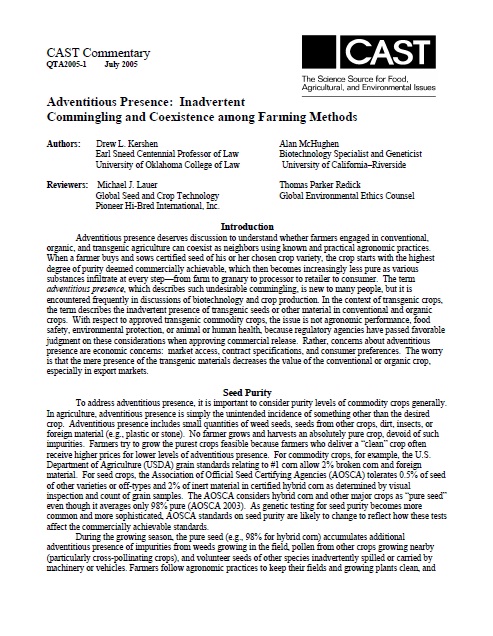
QTA2005-1-Adventitious.jpg
Adventitious presence refers to the unintended commingling of trace amounts of one type of seed, or product, with another. Although this process can occur with conventionally bred crops, adventitious presence is more commonly regarded as the presence of genetically engineered (GE) seed and product in non-GE material. This document will provide a framework to discuss development of a science-based policy for adventitious presence.