CAST papers are developed by interdisciplinary task forces composed of volunteer authors, chairs, reviewers, liaisons, and translators from academia, industry, and government. This index recognizes those contributors and highlights the breadth of expertise that supports CAST’s work.

Alex Thomasson

Affiliation
Mississippi State University
Title/Position
Professor, Department Head, and William B. and Sherry Berry Endowed Chair
Expertise
Agricultural autonomy and robotics; Precision agriculture systems; Remote sensing and image analysis; Drone and UAV-based agricultural sensing; Optoelectronic and optical sensor technologies; Spectroscopy for agricultural applications; Cotton production, processing, and ginning systems; Instrumentation, control systems, and machine design; Bioenergy systems
Bio

J. Alex Thomasson is Professor, Department Head, and William B. and Sherry Berry Endowed Chair in Agricultural and Biological Engineering at Mississippi State University. A leading authority in precision agriculture and agricultural autonomy, his research centers on optical and optoelectronic sensing technologies, drone-based remote sensing, and image analysis to support site-specific crop management, particularly in cotton production and processing systems. Dr. Thomasson has held senior academic and research appointments at Mississippi State University, Texas A&M University, and the USDA Agricultural Research Service, and has authored an extensive body of peer-reviewed work advancing sensor-based, data-driven agricultural systems.


Publications as Task Force Chair
CAST_AI-in-Agriculture
This report examines the current and emerging applications of AI in agriculture, including crop and livestock monitoring, precision management, yield prediction, disease and pest detection, automation, and supply chain optimization. It explores the data sources, algorithms, and digital infrastructure that underpin AI-driven systems, as well as the role of AI in enhancing sustainability, productivity, and resilience under climate and resource constraints.
Publications as Author
CAST_AI+in+Agriculture
Artificial intelligence is reshaping U.S. agriculture — embedded in field equipment, production systems, food processing, supply chains, and natural resource management. This issue paper examines how AI has moved beyond data collection to active decision-making and physical action, and what that shift means for producers, policymakers, and the broader food system. It reviews applications across the agricultural value chain, analyzes the data infrastructure and governance conditions that responsible adoption requires, and offers policy considerations spanning data investment, rural infrastructure, interoperability, workforce preparation, and standards for autonomous systems.
COVID-Impacts
This commentary evaluates how agricultural science and technology can support implementation of the federal Climate 21 Project, which positions the U.S. Department of Agriculture as a central actor in national climate mitigation and resilience strategies. Agriculture and forestry are highlighted as the only major sectors capable of becoming net greenhouse gas sinks, offering substantial potential to help the United States reach net‑zero emissions by 2050 through soil carbon sequestration, improved nutrient management, reduced tillage, and strengthened crop and livestock systems.
IP70_cover.jpg
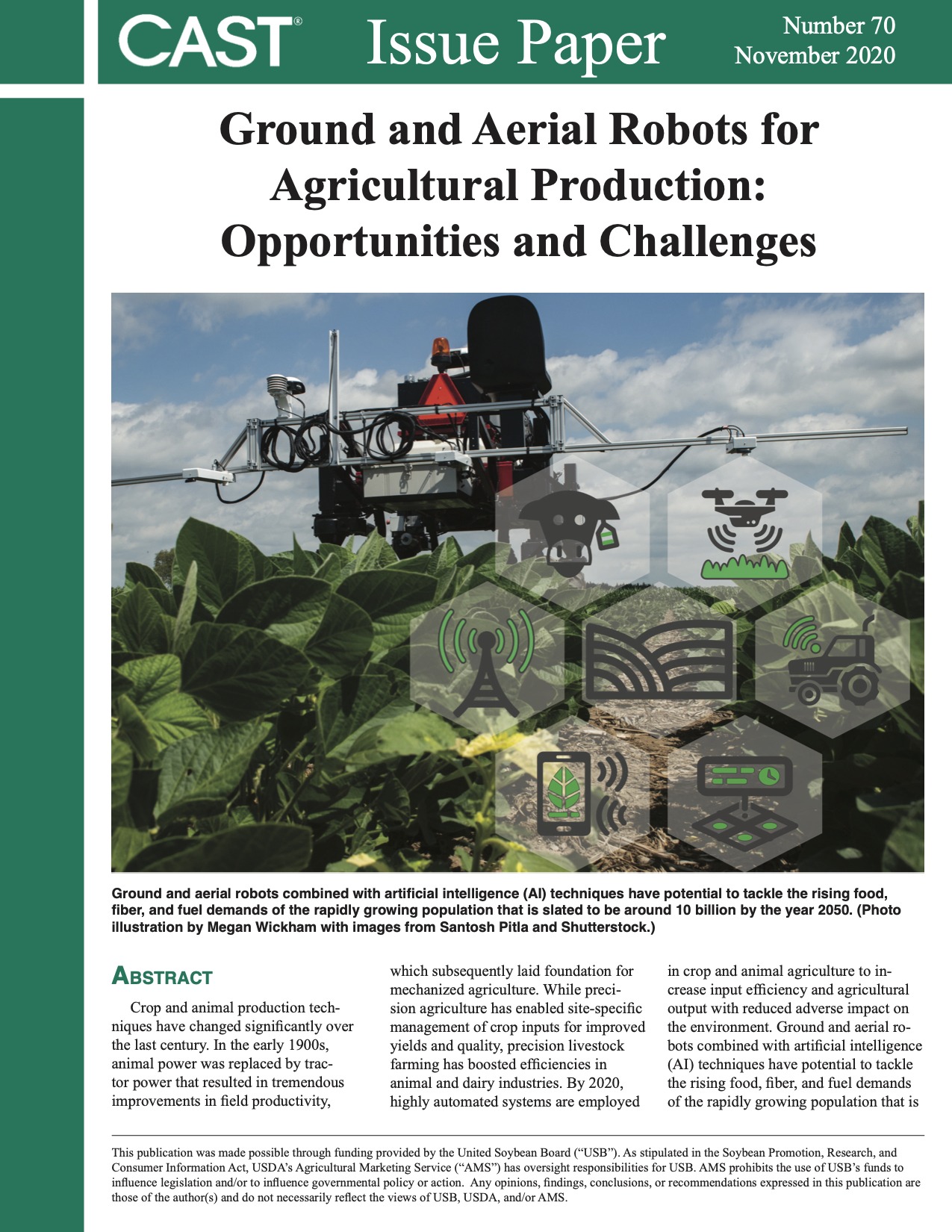
This paper examines the emerging roles of ground and aerial robotic systems—unmanned ground vehicles (UGVs), unmanned aerial systems (UASs), and robotic manipulators—in crop and livestock systems.