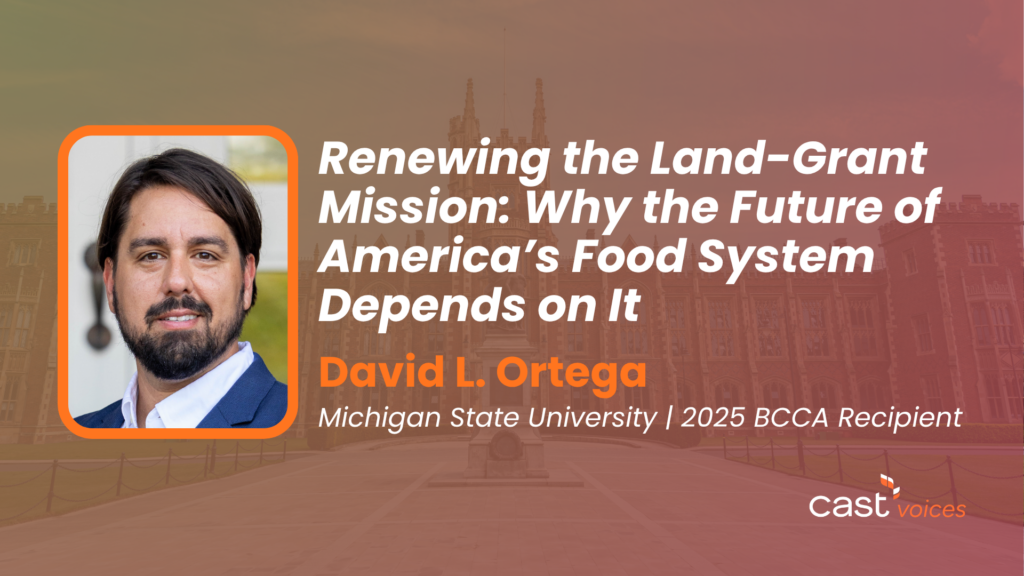

By David L. Ortega
Professor and Noel W. Stuckman Chair in Food Economics and Policy in the Department of Agricultural, Food, and Resource Economics at Michigan State University, and the 2025 Borlaug CAST Communication Award recipient
Walk into any American grocery store and you are looking at one of the most remarkable systems ever built. Behind every shelf sits more than a century and a half of public investment in agricultural science, education, and outreach. It is one of the quiet success stories of American history.
And yet, despite its extraordinary success, that system is beginning to erode.
A Quiet Success Story Worth Defending
The land-grant university system, established through the Morrill Act of 1862, rested on a radical idea for its time: knowledge about food, land, and rural prosperity should be treated as a public good. Through its tripartite mission of education, research, and extension, the land-grant system transformed American agriculture into the most productive in the world. It strengthened rural communities, made food more abundant and affordable for generations of families, and helped position the United States as the global leader in agricultural innovation.
My own office at Michigan State University, the nation’s pioneer land-grant institution, sits in Morrill Hall, named after Congressman Justin Morrill, whose vision helped make this system possible. My career is a product of this system. I earned my undergraduate degree at the University of Florida and my doctorate at Purdue University, both land-grant institutions dedicated to the idea that agricultural knowledge should serve the common good.
A System Bent but Not Broken
Over the past several years, the U.S. food system has absorbed shock after shock: a global pandemic, Russia’s invasion of Ukraine that destabilized grain and fertilizer markets, repeated outbreaks of highly pathogenic avian influenza, persistent drought across cattle country, accelerating climate-related disruptions to crops and livestock, rising trade tensions and tariffs, and volatility in global energy markets linked to conflict in the Middle East.
At their peak in 2022, grocery prices rose roughly 13 percent year over year, levels Americans had not seen in four decades. The strain on household budgets was real, especially for lower-income families.
But the more remarkable story is not that food prices rose. It is that the system continued functioning under extraordinary pressure. Grocery stores remained stocked. Farmers adapted. Supply chains adjusted. The system bent under compounding shocks, but it did not break.
That resilience was not luck. It was the payoff from decades of sustained public investment.
Falling Behind While the Stakes Rise
Here is what should concern every American who cares about the future of food: that investment has been quietly eroding for years.
According to the USDA Economic Research Service, U.S. public spending on agricultural research and development peaked in the early 2000s and, after adjusting for inflation, declined substantially over the following two decades. By 2021, public agricultural R&D spending had fallen back to levels comparable to those of the 1970s.
Other countries have moved in the opposite direction.
Having spent much of my career studying China’s agricultural and food system, I witnessed this shift firsthand: state-of-the-art laboratories, sophisticated data systems, and research infrastructure that increasingly rival what one finds at top American universities. China’s public agricultural R&D spending increased dramatically between 2000 and the late 2010s, surpassed U.S. spending around 2008, and by the mid-2010s was estimated to be roughly double U.S. public spending. Brazil and India have also significantly expanded their investments in agricultural science and innovation.
This is not simply a competition over scientific prestige. It is a competition over who will shape the future of the global food system. Food security, technological leadership, and geopolitical influence are increasingly intertwined.
Climate Resilience and Food Affordability Begin with Research
When many people hear the phrase “agricultural research,” they picture a laboratory. But agricultural innovation reaches far beyond laboratories and field experiments.
It includes the genetics that make livestock more resistant to disease. The agronomy that helps crops withstand drought and extreme heat. The cold-chain logistics that reduce food waste during transportation. The extension specialist helping a producer adapt to shifting climate conditions or emerging pests.
These advances do not emerge overnight. They are the product of long-term investment.
Those investments also bear directly on what families pay at the grocery store. Few public investments deliver the kind of long-run returns that agricultural research does. Those returns reach consumers as higher yields, fewer losses to pests and disease, and less spoilage between farm and table — the cumulative force that has quietly made food more affordable for American families over generations. When research stalls, the engine slows, and the cost eventually shows up at the checkout.
Climate change makes that investment more urgent, not less. The pests, diseases, and weather extremes producers face over the next twenty years will not resemble those of the previous twenty. The breeding programs, water management technologies, and economic research needed to adapt take decades to build, but only years to dismantle.
The countries investing today are positioning themselves to lead the food system of 2050.
Renewing the Mission
The future of America’s food and agricultural system will depend on whether we are willing to renew the land-grant mission that helped build it.
That means sustaining investments in research whose benefits may take decades to fully materialize. It means supporting extension systems that rarely make headlines but quietly improve resilience and productivity across rural America. It means educating the next generation of agricultural scientists, economists, engineers, and producers.
In short, it requires stewardship.
The American food system remains one of the great success stories of public investment in U.S. history. But its future is not guaranteed. It depends on whether we are willing to invest in it again. That is a choice worth making.
___
About Voices of Agriculture
The Voices of Agriculture series is designed to provide a platform for diverse perspectives on issues, trends, and experiences within the agricultural community. These articles aim to foster dialogue, share insights, and highlight the many voices that contribute to the ongoing conversation about agriculture and its future.
Disclaimer
The opinions expressed in this article are solely those of the author. They do not necessarily represent the views, positions, or policies of the Council for Agricultural Science and Technology (CAST). CAST provides this space to encourage thoughtful discussion, but does not endorse any specific viewpoints shared in these pieces.