CAST papers are developed by interdisciplinary task forces composed of volunteer authors, chairs, reviewers, liaisons, and translators from academia, industry, and government. This index recognizes those contributors and highlights the breadth of expertise that supports CAST’s work.

Allan Felsot

Affiliation
Washington State University
Publications as Author
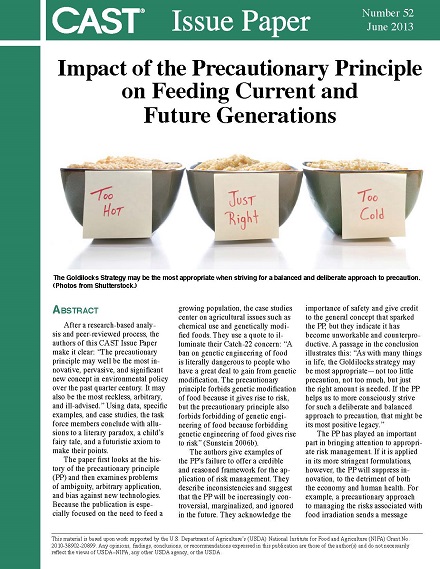
CAST-IP52_Precautionary-Principle.jpg
Este documento analiza críticamente el Principio Precautorio (PP) y su creciente influencia en las políticas relacionadas con los alimentos y la agricultura. Aunque el PP surgió como una herramienta destinada a proteger la salud humana y el ambiente ante la incertidumbre científica, los autores muestran que, en la práctica, su ambigüedad, falta de criterios claros y aplicación arbitraria lo han convertido en un obstáculo para la innovación y la seguridad alimentaria.
CAST IP52_Precautionary Principle
This paper looks at the history and purpose of the precautionary principle (PP) and examines problems of ambiguity, arbitrary application, and bias against new technologies. Because the publication (IP 52) is especially focused on the need to feed a growing population, the case studies center on agricultural issues such as pesticide use, genetically modified foods, and food irradiation. The authors state that the PP has played an important part in bringing attention to appropriate risk management. If it is applied in its more stringent formulations, however, the PP will suppress innovation, to the detriment of both the economy and human health.
U_S__Soybean_Board_Report_full_text_AA545DA1192C1
A comprehensive review of the scientific literature supports the conclusion that overall the currently commercialized biotechnology-derived soybean, corn, and cotton crops yield environmental benefits. Furthermore, a critical analysis of the literature supports the idea that biotechnology-derived soybean, corn, and cotton pose no environmental concerns unique to or different from those historically associated with conventionally developed crop varieties.
Publications as Reviewer
alfalfa-gene-flow-paper-in-spanish-cover.jpg
Esta publicación aborda el flujo de genes en la alfalfa (Medicago sativa L.) y sus implicaciones para la coexistencia entre sistemas de producción genéticamente modificados (GE), convencionales y orgánicos. Explica los factores biológicos y agronómicos que influyen en el movimiento génico a través del polen y la semilla, y describe estrategias de mitigación para minimizar la presencia adventicia (AP) de rasgos GE en mercados sensibles.
CAST-SP30_US-Soybean-Production.jpg
This CAST Special Publication documents the ecological and economic implications of the various systems used in U.S. soybean production. Soybean production has changed in the United States since its first introduction in the mid-1880s. Initially, the crop was produced mainly for forage and received only minimal inputs. Today, soybeans have become a major source of protein in animal diets and vegetable oils for human consumption. Considering this dramatic change, CAST is providing a comprehensive literature review that evaluates U.S. soybean production systems currently in use with respect to their environmental and economic sustainability.
CAST-SP28_Gene-Flow-Alfalfa.jpg
This Special Publication describes the biology and agronomic practices in alfalfa that should be considered in developing coexistence strategies to allow growers to have choices, specifically between genetically engineered (GE), conventional, and GE-sensitive markets in the United States. These strategies are based on science and are a direct extension of well-established coexistence principles routinely used by seed growers. The management practices currently being used by growers of Roundup Ready alfalfa seed are presented as an example of strategies developed by the alfalfa seed industry that allow coexistence of different production systems.